
Ch.11 - Liquids and Intermolecular Forces
Brown - Chemistry: The Central Science 14th Edition
Brown14th EditionChemistry: The Central ScienceISBN: 9780134414232당신이 사용하는 게 아니라요?교과서 변경
11장, 문제 69

For a given substance, the liquid crystalline phase tends to be more viscous than the liquid phase. Why?

검증된 단계별 안내
1
1. The liquid crystalline phase is a state of matter that has properties between those of conventional liquids and those of solid crystals. This phase is characterized by an ordered structure like a crystal, but also has the ability to flow like a liquid.
2. The increased viscosity in the liquid crystalline phase compared to the liquid phase is due to the increased order in the system. In a liquid, the molecules are free to move around and slide past each other, which results in a lower viscosity.
3. In a liquid crystalline phase, the molecules are partially ordered. This means that while they can still move around, they do so in a more restricted and coordinated manner. This increased order and coordination makes it harder for the molecules to slide past each other, which increases the viscosity.
4. The increased viscosity of the liquid crystalline phase can also be attributed to the increased intermolecular forces. The ordered structure of the liquid crystalline phase allows for more interactions between molecules, which can increase the resistance to flow.
5. Therefore, the liquid crystalline phase tends to be more viscous than the liquid phase due to the increased order and intermolecular forces in the system.

비슷한 문제에 대한 검증된 영상 답변:

이 영상 해법은 위 문제에 도움이 된다고 튜터들이 추천한 것입니다.
영상 길이:
1m
도움이 되었나요?

주요 개념

질문에 올바르게 답하기 위해 반드시 이해해야 하는 핵심 개념들은 다음과 같습니다.

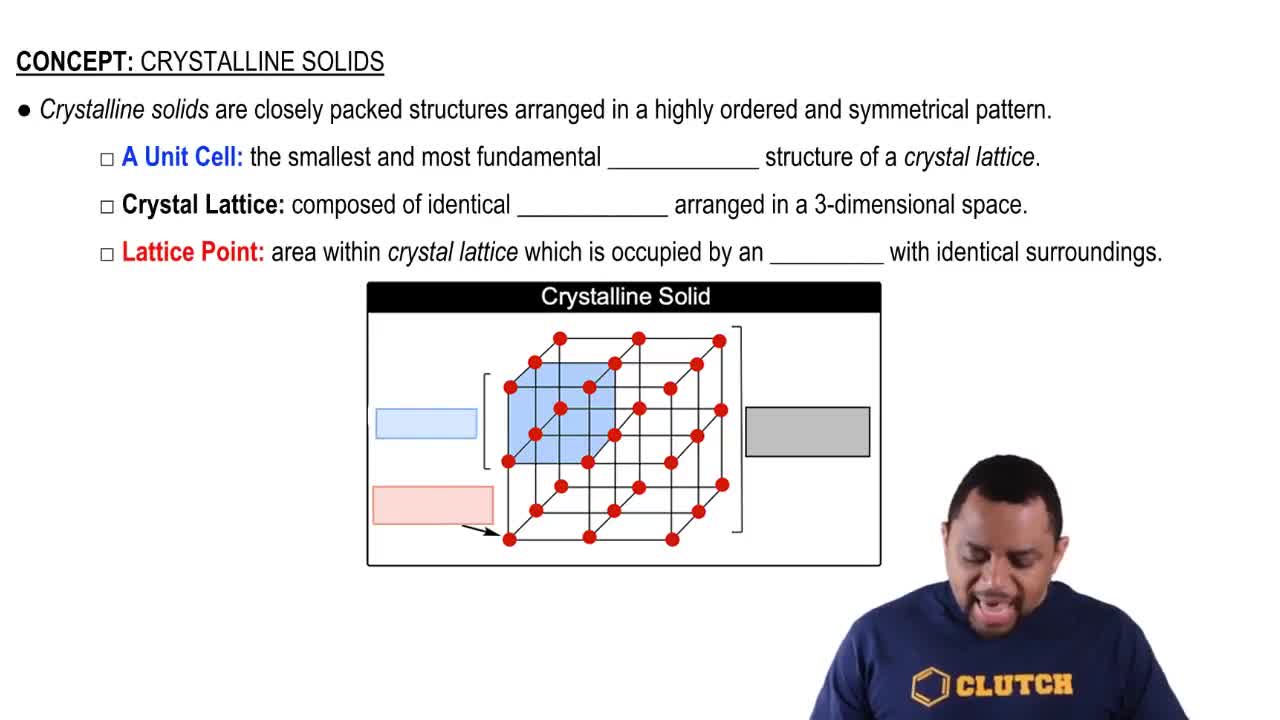
Liquid Crystalline Phase

The liquid crystalline phase is a state of matter that exhibits properties of both liquids and solid crystals. In this phase, molecules are organized in a way that allows for some fluidity while maintaining a degree of order, which can lead to unique optical and mechanical properties. This organization can affect how the substance flows and interacts with its environment.
추천 영상:
가이드 코스
01:31
Crystalline Solids Structure

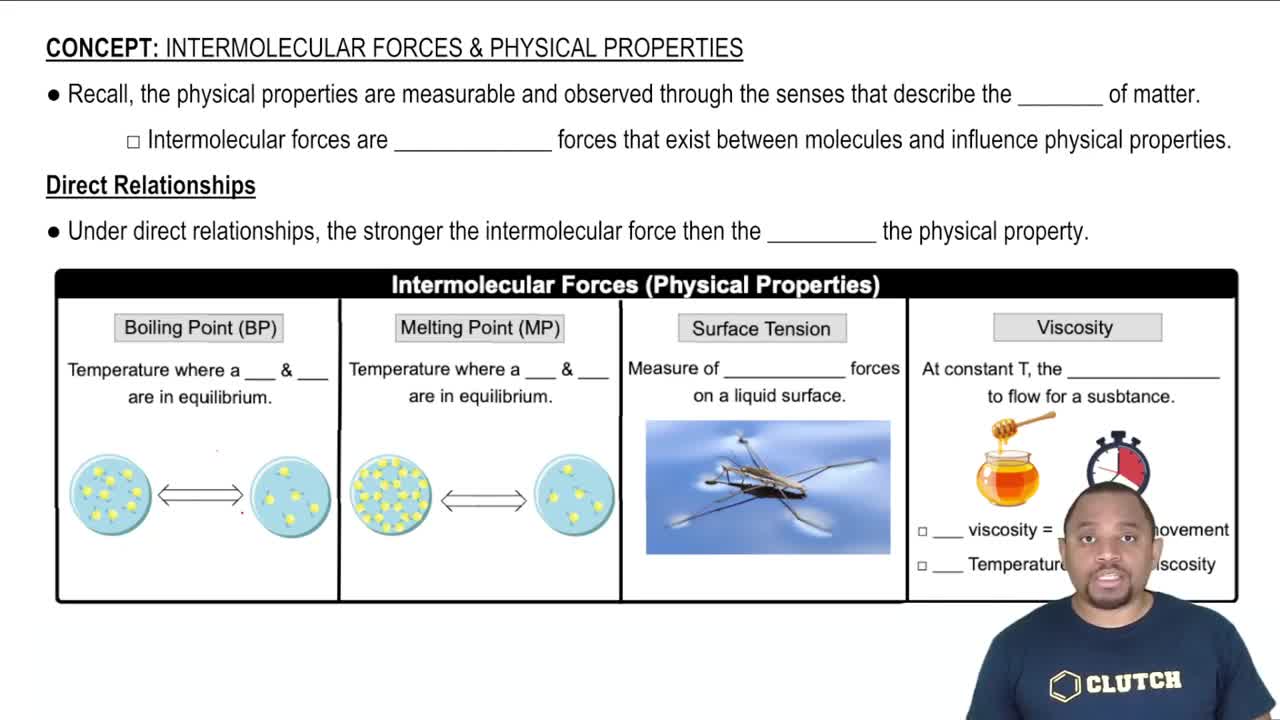
Viscosity

Viscosity is a measure of a fluid's resistance to flow. It is influenced by factors such as temperature, molecular structure, and intermolecular forces. A higher viscosity indicates a thicker fluid that flows more slowly, while a lower viscosity indicates a thinner fluid that flows more easily. Understanding viscosity is crucial for comparing the flow characteristics of different phases of a substance.
추천 영상:
가이드 코스
03:13
Intermolecular Forces and Properties

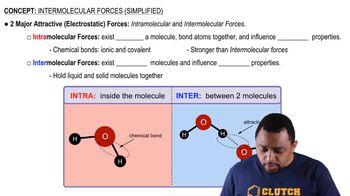
Intermolecular Forces

Intermolecular forces are the attractive forces between molecules that influence their physical properties, including viscosity. In the liquid crystalline phase, these forces can be stronger or more organized due to the alignment of molecules, leading to increased resistance to flow compared to the more randomly arranged molecules in the liquid phase. This difference in molecular arrangement directly impacts the viscosity of the substance.
추천 영상:
가이드 코스
01:59
Intermolecular vs Intramolecular Forces