Ch.11 - Liquids and Intermolecular Forces
Brown - Chemistry: The Central Science 14th Edition
Brown14th EditionChemistry: The Central ScienceISBN: 9780134414232당신이 사용하는 게 아니라요?교과서 변경
11장, 문제 67c

Indicate whether each statement is true or false: (c) Molecules that exhibit a liquid crystalline phase do so at well-defined temperatures and pressures.

검증된 단계별 안내
1
Step 1: Understand the concept of liquid crystalline phase. Liquid crystals are a state of matter that has properties between those of conventional liquids and those of solid crystals. They can flow like a liquid, but have the molecular order of a crystal.
Step 2: Consider the statement 'Molecules that exhibit a liquid crystalline phase do so at well-defined temperatures and pressures.'
Step 3: Recall that the phase of a substance (solid, liquid, gas, or liquid crystal) is determined by temperature and pressure. For a given substance, there are specific ranges of temperature and pressure at which it will exhibit a particular phase.
Step 4: Apply this knowledge to the statement. If a molecule can exhibit a liquid crystalline phase, it will do so at specific temperatures and pressures.
Step 5: Therefore, the statement 'Molecules that exhibit a liquid crystalline phase do so at well-defined temperatures and pressures.' is true.

비슷한 문제에 대한 검증된 영상 답변:

이 영상 해법은 위 문제에 도움이 된다고 튜터들이 추천한 것입니다.
영상 길이:
45s
도움이 되었나요?

주요 개념

질문에 올바르게 답하기 위해 반드시 이해해야 하는 핵심 개념들은 다음과 같습니다.

Liquid Crystals

Liquid crystals are states of matter that have properties between those of conventional liquids and solid crystals. They can flow like a liquid but have some degree of order, particularly in their molecular arrangement. This unique phase allows them to exhibit anisotropic properties, meaning their optical and physical properties can vary based on direction.
추천 영상:
가이드 코스
03:04
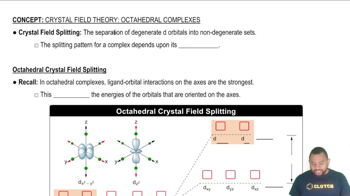
The crystal field splitting pattern for octahedral complexes has the d orbitals on or along the axes as having the higher energy.

Phase Transition

A phase transition is the transformation of a substance from one state of matter to another, such as from solid to liquid or liquid to gas. For liquid crystals, these transitions occur at specific temperatures and pressures, where the molecular arrangement changes, leading to distinct phases like nematic or smectic. Understanding these transitions is crucial for determining the conditions under which liquid crystals exhibit their unique properties.
추천 영상:
가이드 코스
03:22
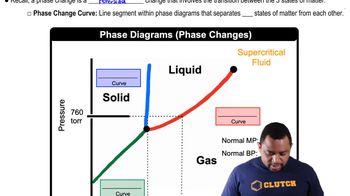
Phase Changes in Diagrams

Thermodynamic Stability

Thermodynamic stability refers to the conditions under which a substance maintains its phase without spontaneous change. For liquid crystals, this stability is influenced by temperature and pressure, which dictate the phase they occupy. At well-defined temperatures and pressures, liquid crystals can exist in a stable state, making it essential to understand these parameters when evaluating their behavior.
추천 영상:
가이드 코스
01:18
First Law of Thermodynamics