
Ch.11 - Liquids and Intermolecular Forces
Brown - Chemistry: The Central Science 14th Edition
Brown14th EditionChemistry: The Central ScienceISBN: 9780134414232당신이 사용하는 게 아니라요?교과서 변경
11장, 문제 35b

Liquids can interact with flat surfaces just as they can with capillary tubes; the cohesive forces within the liquid can be stronger or weaker than the adhesive forces between liquid and surface:
(b) Which of these diagrams, i or ii, rep- resents what happens when water is on a nonpolar surface?

검증된 단계별 안내
1
Step 1: Understand the concepts of cohesive and adhesive forces. Cohesive forces are the intermolecular forces between the molecules of the liquid, while adhesive forces are the forces between the liquid molecules and the surface.
Step 2: Recognize that water is a polar molecule, meaning it has a partial positive charge on one side and a partial negative charge on the other.
Step 3: Identify that a nonpolar surface does not have a charge distribution that can interact strongly with the polar water molecules.
Step 4: Compare the two diagrams (i and ii) to determine which one shows water on a nonpolar surface. Look for signs of weak interaction between the water and the surface, such as water forming droplets due to strong cohesive forces within the water.
Step 5: Conclude that the diagram where water forms droplets (indicating strong cohesive forces and weak adhesive forces) represents water on a nonpolar surface.

비슷한 문제에 대한 검증된 영상 답변:

이 영상 해법은 위 문제에 도움이 된다고 튜터들이 추천한 것입니다.
영상 길이:
1m
도움이 되었나요?

주요 개념

질문에 올바르게 답하기 위해 반드시 이해해야 하는 핵심 개념들은 다음과 같습니다.

Cohesive Forces

Cohesive forces are the intermolecular forces that hold molecules of the same substance together. In liquids, these forces are responsible for phenomena such as surface tension, where the molecules at the surface experience a net inward force due to stronger interactions with neighboring molecules. Understanding cohesive forces is essential for predicting how a liquid behaves on different surfaces.
추천 영상:
가이드 코스
03:13
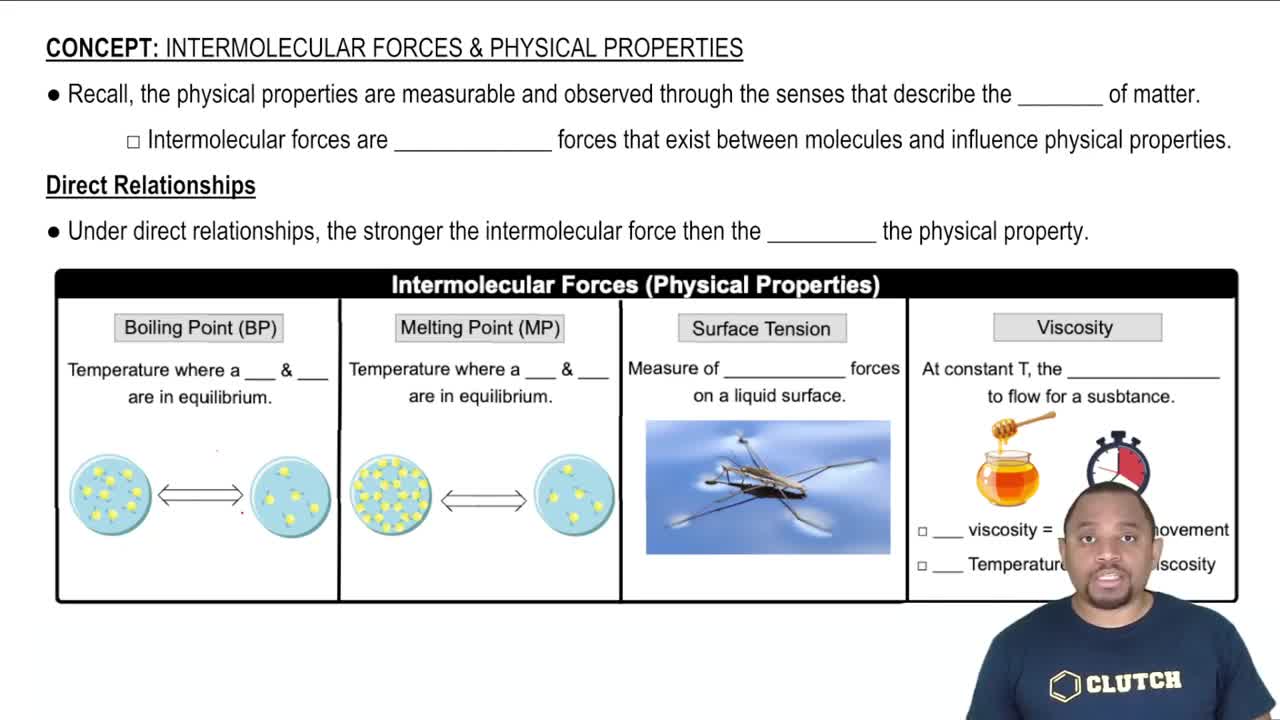
Intermolecular Forces and Properties

Adhesive Forces

Adhesive forces are the attractive forces between molecules of different substances. When a liquid comes into contact with a surface, adhesive forces determine how well the liquid spreads or wets the surface. In the case of water on a nonpolar surface, the adhesive forces are typically weaker than the cohesive forces, leading to minimal wetting and the formation of droplets.
추천 영상:
가이드 코스
06:44
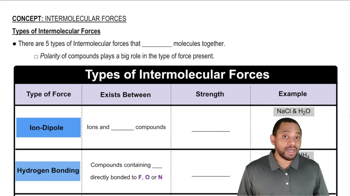
Types of Intermolecular Forces

Wetting and Contact Angle

Wetting refers to the ability of a liquid to maintain contact with a solid surface, influenced by the balance of cohesive and adhesive forces. The contact angle is a measure of this wetting; a smaller angle indicates better wetting. On nonpolar surfaces, water tends to form a larger contact angle, indicating poor wetting, which is crucial for interpreting the diagrams in the question.
추천 영상: