
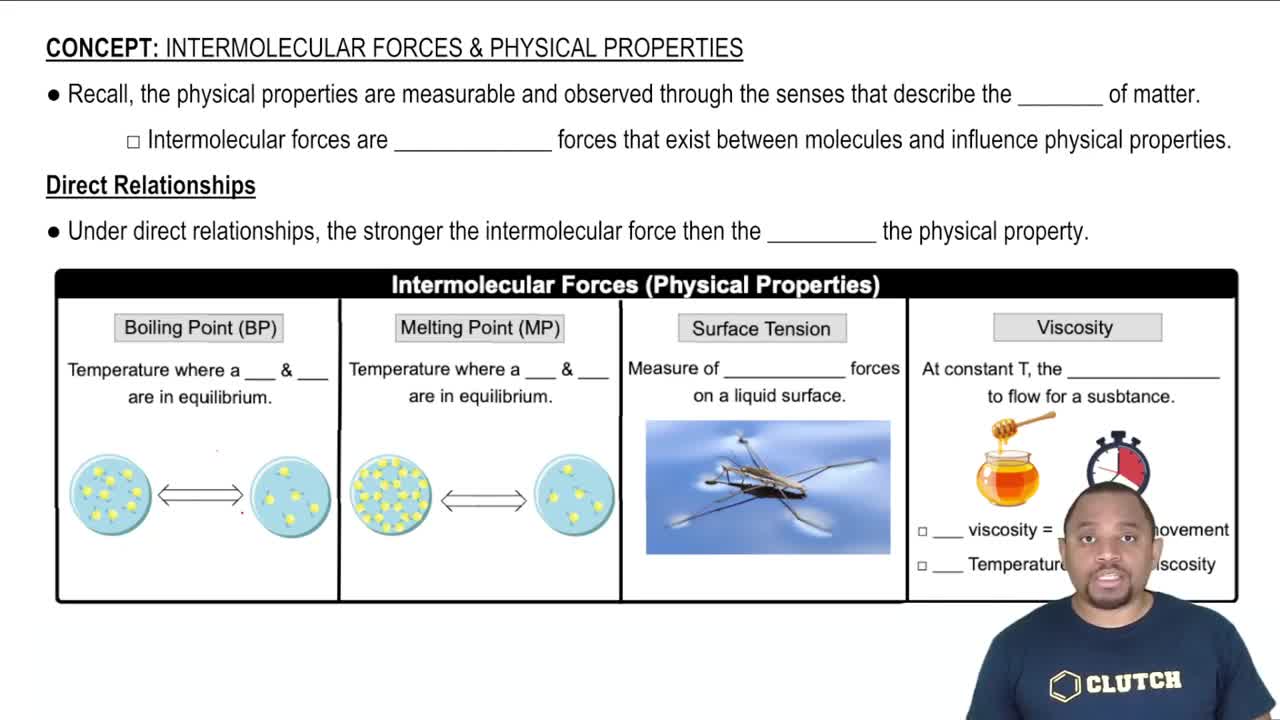
Based on their composition and structure, list CH2Cl2, CH3CH2CH3, and CH3CH2OH in order of (a) increasing intermolecular forces (c) increasing surface tension
검증된 단계별 안내
비슷한 문제에 대한 검증된 영상 답변:
주요 개념
Surface Tension
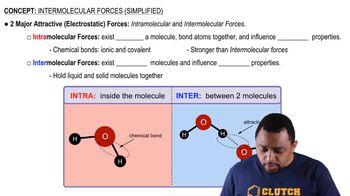
Intermolecular Forces
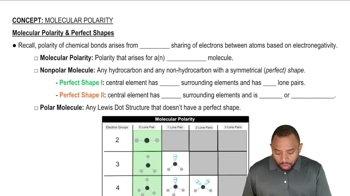
Molecular Structure and Polarity
(b) What is the relationship between viscosity and temperature?
The generic structural formula for a 1-alkyl-3-methylimid- azolium cation is where R is a -CH2(CH2)nCH3 alkyl group. The melting points of the salts that form between 1-alkyl-3-methylimidazolium cation and the PF6- anion are as follows: R = CH2CH3 (m.p. = 60 °C), R = CH2CH2CH3 (m.p. = 40 °C), r = CH2CH2CH2CH3 (m.p. = 10 °C), and R = CH2CH2CH2CH2CH2CH3 (m.p. = -61 °C). Why does the melting point decrease as the length of alkyl group increases?
Liquids can interact with flat surfaces just as they can with capillary tubes; the cohesive forces within the liquid can be stronger or weaker than the adhesive forces between liquid and surface:
(b) Which of these diagrams, i or ii, rep- resents what happens when water is on a nonpolar surface?
(c) Why do substances with high surface tension also tend to have high viscosities?
