
Ch.11 - Liquids and Intermolecular Forces
Brown - Chemistry: The Central Science 14th Edition
Brown14th EditionChemistry: The Central ScienceISBN: 9780134414232당신이 사용하는 게 아니라요?교과서 변경
11장, 문제 75

Suppose you have two colorless molecular liquids, one boiling at -84 °C, the other at 34 °C, both at atmospheric pressure. Which of the following statements is correct? For each statement that is not correct, modify the statement so that it is correct. (a) The higher-boiling liquid has greater total intermolecular forces than the lower-boiling liquid. (b) The lower-boiling liquid must consist of nonpolar molecules. (c) The lower-boiling liquid has a lower molecular weight than the higher-boiling liquid.

검증된 단계별 안내
1
Step 1: Understand the relationship between boiling point and intermolecular forces. The boiling point of a liquid is influenced by the strength of its intermolecular forces. Generally, a higher boiling point indicates stronger intermolecular forces. Therefore, statement (a) is correct: 'The higher-boiling liquid has greater total intermolecular forces than the lower-boiling liquid.'
Step 2: Evaluate statement (b) regarding polarity. While nonpolar molecules often have lower boiling points due to weaker intermolecular forces like London dispersion forces, it is not a definitive rule that a lower-boiling liquid must consist of nonpolar molecules. Modify statement (b) to: 'The lower-boiling liquid may consist of nonpolar molecules, but it is not necessarily nonpolar.'
Step 3: Consider the relationship between molecular weight and boiling point for statement (c). While molecular weight can influence boiling point, it is not the sole factor. Other factors like molecular structure and type of intermolecular forces also play significant roles. Modify statement (c) to: 'The lower-boiling liquid may have a lower molecular weight than the higher-boiling liquid, but molecular weight alone does not determine boiling point.'
Step 4: Reflect on the types of intermolecular forces. The higher-boiling liquid likely has stronger forces such as hydrogen bonding or dipole-dipole interactions, while the lower-boiling liquid may rely more on weaker forces like London dispersion forces.
Step 5: Summarize the corrected statements: (a) is correct as is. (b) should be modified to indicate that the lower-boiling liquid may be nonpolar but is not necessarily so. (c) should be modified to reflect that molecular weight is one of several factors influencing boiling point.

주요 개념

질문에 올바르게 답하기 위해 반드시 이해해야 하는 핵심 개념들은 다음과 같습니다.

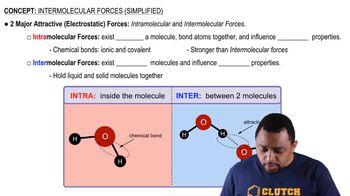
Intermolecular Forces

Intermolecular forces are the attractive forces between molecules that influence physical properties such as boiling points. Stronger intermolecular forces, such as hydrogen bonding or dipole-dipole interactions, typically result in higher boiling points, as more energy is required to separate the molecules. Conversely, weaker forces, like London dispersion forces, lead to lower boiling points.
추천 영상:
가이드 코스
01:59
Intermolecular vs Intramolecular Forces

Boiling Point and Molecular Structure

The boiling point of a substance is the temperature at which its vapor pressure equals atmospheric pressure, allowing it to transition from liquid to gas. This property is significantly affected by the molecular structure, including polarity and molecular weight. Generally, polar molecules have higher boiling points than nonpolar ones due to stronger intermolecular attractions.
추천 영상:
가이드 코스
03:05
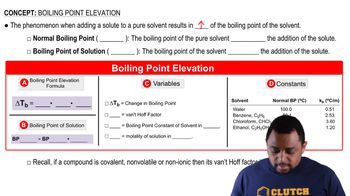
Boiling Point Elevation

Molecular Weight and Boiling Point

Molecular weight refers to the mass of a molecule, which can influence its boiling point. In many cases, larger molecules with higher molecular weights exhibit higher boiling points due to increased van der Waals forces. However, this is not a strict rule, as the type of intermolecular forces present can also play a critical role in determining boiling points.
추천 영상:
가이드 코스
03:05
Boiling Point Elevation