
Ch.11 - Liquids and Intermolecular Forces
Brown - Chemistry: The Central Science 14th Edition
Brown14th EditionChemistry: The Central ScienceISBN: 9780134414232당신이 사용하는 게 아니라요?교과서 변경
11장, 문제 75e

Suppose you have two colorless molecular liquids, one boiling at - 84 °C, the other at 34 °C, and both at atmospheric 6 pressure. Which of the following statements is correct? For each statement that is not correct, modify the statement so that it is correct. (e) At - 84 °C both liquids have vapor pressures of 760 mm Hg.

검증된 단계별 안내
1
Identify the boiling point of each liquid: Liquid A boils at -84 °C and Liquid B boils at 34 °C.
Understand that the boiling point of a liquid is the temperature at which its vapor pressure equals the external pressure, typically 760 mm Hg at atmospheric pressure.
Since Liquid A boils at -84 °C, its vapor pressure is 760 mm Hg at this temperature.
Since Liquid B boils at 34 °C, its vapor pressure is 760 mm Hg at this temperature.
Therefore, at -84 °C, only Liquid A has a vapor pressure of 760 mm Hg, not both liquids.

비슷한 문제에 대한 검증된 영상 답변:

이 영상 해법은 위 문제에 도움이 된다고 튜터들이 추천한 것입니다.
영상 길이:
59s

주요 개념

질문에 올바르게 답하기 위해 반드시 이해해야 하는 핵심 개념들은 다음과 같습니다.

Boiling Point and Vapor Pressure

The boiling point of a liquid is the temperature at which its vapor pressure equals the atmospheric pressure. At this point, the liquid transitions to a gas. For the liquid boiling at -84 °C, it will have a vapor pressure of 760 mm Hg at that temperature, but the other liquid, boiling at 34 °C, will not necessarily have the same vapor pressure at -84 °C.
추천 영상:
가이드 코스
03:05
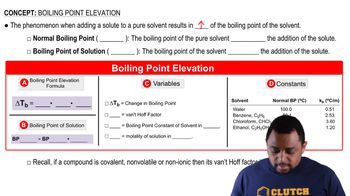
Boiling Point Elevation

Vapor Pressure and Temperature Relationship

Vapor pressure is the pressure exerted by a vapor in equilibrium with its liquid at a given temperature. As temperature increases, the vapor pressure of a liquid also increases. Therefore, at -84 °C, the vapor pressures of both liquids will be lower than 760 mm Hg, making the statement about both having the same vapor pressure at that temperature incorrect.
추천 영상:
가이드 코스
02:40
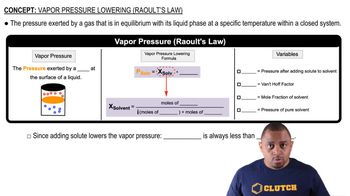
Raoult's Law and Vapor Pressure

Atmospheric Pressure

Atmospheric pressure is the pressure exerted by the weight of the atmosphere at a given location, typically measured at sea level as 760 mm Hg. This pressure is crucial for understanding boiling points and vapor pressures, as liquids will boil when their vapor pressure matches this atmospheric pressure. The statement in question fails to consider that vapor pressures vary with temperature and are not constant across different liquids.
추천 영상:
가이드 코스
02:09
Total Pressure Example