(b) A flask of water is connected to a vacuum pump. A few moments after the pump is turned on, the water begins to boil. After a few minutes, the water begins to freeze. Explain why these processes occur.
Ch.11 - Liquids and Intermolecular Forces
11장, 문제 85
Suppose the vapor pressure of a substance is measured at two different temperatures. (a) By using the Clausius–Clapeyron equation (Equation 11.1) derive the following relationship between the vapor pressures, P1 and P2, and the absolute temperatures at which they were measured, T1 and T2: (b) Gasoline is a mixture of hydrocarbons, a component of which is octane (CH3CH2CH2CH2CH2CH2CH2CH3). Octane has a vapor pressure of 13.95 torr at 25 °C and a vapor pressure of 144.78 torr at 75 °C. Use these data and the equation in part (a) to calculate the heat of vaporization of octane. (c) By using the equation in part (a) and the data given in part (b), calculate the normal boiling point of octane. Compare your answer to the one you obtained from Exercise 11.81. (d) Calculate the vapor pressure of octane at - 30 °C.
검증된 단계별 안내1
1. The Clausius-Clapeyron equation is given by: \(\ln\left(\frac{P_2}{P_1}\right) = -\frac{\Delta H_{vap}}{R}\left(\frac{1}{T_2} - \frac{1}{T_1}\right)\), where \(P_1\) and \(P_2\) are the vapor pressures at temperatures \(T_1\) and \(T_2\) respectively, \(\Delta H_{vap}\) is the heat of vaporization, and \(R\) is the ideal gas constant. This equation allows us to relate the change in vapor pressure of a substance with the change in temperature.
2. To calculate the heat of vaporization of octane, we can rearrange the Clausius-Clapeyron equation to solve for \(\Delta H_{vap}\): \(\Delta H_{vap} = -R\left(\frac{1}{T_2} - \frac{1}{T_1}\right)\ln\left(\frac{P_2}{P_1}\right)\). We can then substitute the given values for \(P_1\), \(P_2\), \(T_1\), and \(T_2\) into this equation. Remember to convert the temperatures from Celsius to Kelvin by adding 273.15.
3. To calculate the normal boiling point of octane, we need to find the temperature at which the vapor pressure of octane is equal to 1 atm or 760 torr. We can rearrange the Clausius-Clapeyron equation to solve for \(T_2\): \(T_2 = \frac{1}{\frac{1}{T_1} - \frac{R}{\Delta H_{vap}}\ln\left(\frac{P_2}{P_1}\right)}\). We can then substitute the given values for \(P_1\), \(P_2\), \(T_1\), and the calculated value for \(\Delta H_{vap}\) into this equation.
4. To calculate the vapor pressure of octane at -30 °C, we can use the Clausius-Clapeyron equation again. This time, we rearrange the equation to solve for \(P_2\): \(P_2 = P_1\exp\left(-\frac{\Delta H_{vap}}{R}\left(\frac{1}{T_2} - \frac{1}{T_1}\right)\right)\). We can then substitute the given values for \(P_1\), \(T_1\), the calculated value for \(\Delta H_{vap}\), and the desired temperature \(T_2\) (converted to Kelvin) into this equation.
5. After performing these calculations, you should have the heat of vaporization of octane, the normal boiling point of octane, and the vapor pressure of octane at -30 °C. Remember to check your answers for reasonableness based on what you know about the properties of octane and other similar substances.

비슷한 문제에 대한 검증된 영상 답변:
이 영상 해법은 위 문제에 도움이 된다고 튜터들이 추천한 것입니다.
영상 길이:
3m도움이 되었나요?
주요 개념
질문에 올바르게 답하기 위해 반드시 이해해야 하는 핵심 개념들은 다음과 같습니다.
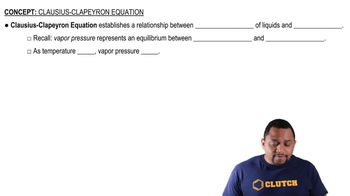
Clausius–Clapeyron Equation
The Clausius–Clapeyron equation describes the relationship between vapor pressure and temperature for a substance in equilibrium between its liquid and vapor phases. It is expressed as ln(P2/P1) = -ΔHvap/R(1/T2 - 1/T1), where P1 and P2 are the vapor pressures at temperatures T1 and T2, ΔHvap is the heat of vaporization, and R is the ideal gas constant. This equation is fundamental for understanding how changes in temperature affect vapor pressure.
추천 영상:
가이드 코스
Clausius-Clapeyron Equation
Heat of Vaporization
The heat of vaporization (ΔHvap) is the amount of energy required to convert a unit mass of a liquid into vapor at constant temperature and pressure. It is a crucial property of substances, influencing their vapor pressures and boiling points. For octane, knowing its vapor pressures at two temperatures allows us to calculate ΔHvap using the Clausius–Clapeyron equation, providing insight into its thermodynamic behavior.
추천 영상:
가이드 코스
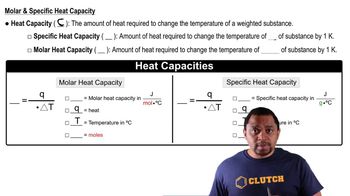
Heat Capacity
Normal Boiling Point
The normal boiling point of a substance is the temperature at which its vapor pressure equals the atmospheric pressure (typically 1 atm). At this point, the liquid phase can transition to the gas phase. By applying the Clausius–Clapeyron equation and the known vapor pressures of octane, one can determine its normal boiling point, which is essential for understanding its phase behavior and applications in various industries.
추천 영상:
가이드 코스
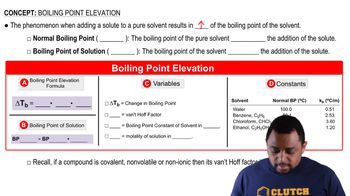
Boiling Point Elevation
관련 실천
교과서 질문
634
views
교과서 질문
Naphthalene (C10H8) is the main ingredient in traditional mothballs. Its normal melting point is 81 °C, its normal boiling point is 218 °C, and its triple point is 80 °C at 1000 Pa. Using the data, construct a phase diagram for naphthalene, labeling all the regions of your diagram.
2401
views
교과서 질문
The following data present the temperatures at which certain vapor pressures are achieved for dichloromethane (CH2Cl2) and methyl iodide (CH3I): (c) The order of volatility of these two substances changes as the temperature is increased. What quantity must be different for the two substances for this phenom- enon to occur?
378
views
교과서 질문
The following table gives the vapor pressure of hexafluorobenzene (C6F6) as a function of temperature: (a) By plotting these data in a suitable fashion, determine whether the Clausius–Clapeyron equation (Equation 11.1) is obeyed. If it is obeyed, use your plot to determine ∆Hvap for C6F6.
576
views
교과서 질문
(a) When you exercise vigorously, you sweat. How does this help your body cool?
436
views