Ch.11 - Liquids and Intermolecular Forces
Brown - Chemistry: The Central Science 14th Edition
Brown14th EditionChemistry: The Central ScienceISBN: 9780134414232당신이 사용하는 게 아니라요?교과서 변경
11장, 문제 83a

(a) When you exercise vigorously, you sweat. How does this help your body cool?

검증된 단계별 안내
1
Understand that sweating is a part of the body's thermoregulation process, which helps maintain a stable internal temperature.
Recognize that when you exercise, your body generates heat, increasing your internal temperature.
Sweat glands in your skin release sweat, which is primarily composed of water, onto the surface of your skin.
As the sweat evaporates from your skin, it absorbs heat from your body, which cools you down. This process is known as evaporative cooling.
The heat required for the evaporation of sweat is taken from your body, thus lowering your body temperature and helping you cool down.

비슷한 문제에 대한 검증된 영상 답변:

이 영상 해법은 위 문제에 도움이 된다고 튜터들이 추천한 것입니다.
영상 길이:
1m
도움이 되었나요?

주요 개념

질문에 올바르게 답하기 위해 반드시 이해해야 하는 핵심 개념들은 다음과 같습니다.

Evaporation and Cooling

Evaporation is the process where liquid turns into vapor, which requires energy. When sweat evaporates from the skin's surface, it absorbs heat from the body, leading to a cooling effect. This is a crucial mechanism for thermoregulation, helping to maintain a stable internal body temperature during vigorous exercise.
추천 영상:
가이드 코스
04:50
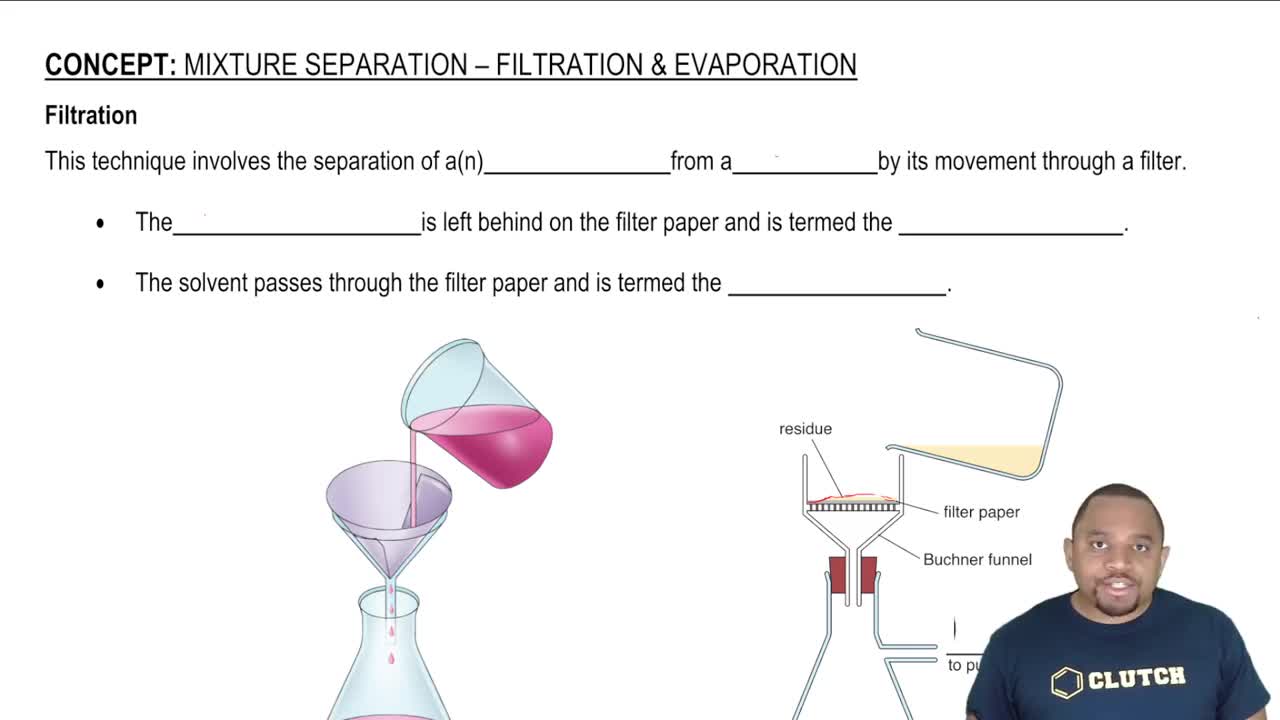
Filtration and Evaporation

Thermoregulation

Thermoregulation is the process by which the body maintains its core internal temperature. During exercise, the body generates heat, and to prevent overheating, it activates mechanisms like sweating. This physiological response is vital for sustaining performance and preventing heat-related illnesses.

Role of Sweat Glands

Sweat glands are specialized structures in the skin that produce sweat, primarily composed of water and electrolytes. When the body temperature rises, these glands are stimulated to release sweat onto the skin's surface. The evaporation of this sweat is essential for effective cooling, as it helps dissipate excess heat generated during physical activity.
추천 영상:
가이드 코스
00:46
Writing Formulas
관련 실천
교과서 질문

Use the normal boiling points propane (C3H8) -42.1 °C butane (C4H10) -0.5 °C pentane (C5H12) 36.1 °C hexane (C6H14) 68.7 °C heptane (C7H16) 98.4 °C to estimate the normal boiling point of octane (C8H18). Explain the trend in the boiling points.

2187
views
교과서 질문

(b) A flask of water is connected to a vacuum pump. A few moments after the pump is turned on, the water begins to boil. After a few minutes, the water begins to freeze. Explain why these processes occur.

634
views
교과서 질문

Suppose the vapor pressure of a substance is measured at two different temperatures. (a) By using the Clausius–Clapeyron equation (Equation 11.1) derive the following relationship between the vapor pressures, P1 and P2, and the absolute temperatures at which they were measured, T1 and T2: (b) Gasoline is a mixture of hydrocarbons, a component of which is octane (CH3CH2CH2CH2CH2CH2CH2CH3). Octane has a vapor pressure of 13.95 torr at 25 °C and a vapor pressure of 144.78 torr at 75 °C. Use these data and the equation in part (a) to calculate the heat of vaporization of octane. (c) By using the equation in part (a) and the data given in part (b), calculate the normal boiling point of octane. Compare your answer to the one you obtained from Exercise 11.81. (d) Calculate the vapor pressure of octane at - 30 °C.

719
views
교과서 질문

The following table gives the vapor pressure of hexafluorobenzene (C6F6) as a function of temperature: (a) By plotting these data in a suitable fashion, determine whether the Clausius–Clapeyron equation (Equation 11.1) is obeyed. If it is obeyed, use your plot to determine ∆Hvap for C6F6.

576
views
교과서 질문

The table below shows the normal boiling points of benzene and benzene derivatives. (e) Why is the boiling point of phenol the highest of all?

775
views
1
rank