(c) What atomic orbitals are involved in the stacking of graphite sheets with each other?
Ch.12 - Solids and Modern Materials
12장, 문제 126a
(a) What are the C—C—C bond angles in diamond?

검증된 단계별 안내1
Identify the structure of diamond, which is a three-dimensional network of carbon atoms.
Recognize that each carbon atom in diamond is sp3 hybridized, forming four single covalent bonds with other carbon atoms.
Understand that in an sp3 hybridized carbon, the bond angles are determined by the tetrahedral geometry.
Recall that the ideal bond angle in a tetrahedral geometry is 109.5 degrees.
Conclude that the C-C-C bond angles in diamond are approximately 109.5 degrees.

비슷한 문제에 대한 검증된 영상 답변:
이 영상 해법은 위 문제에 도움이 된다고 튜터들이 추천한 것입니다.
영상 길이:
1m도움이 되었나요?
주요 개념
질문에 올바르게 답하기 위해 반드시 이해해야 하는 핵심 개념들은 다음과 같습니다.
Tetrahedral Geometry
In diamond, each carbon atom is bonded to four other carbon atoms in a tetrahedral arrangement. This geometry arises from the sp3 hybridization of carbon, where the bond angles between the carbon-carbon bonds are approximately 109.5 degrees. This spatial arrangement contributes to the strength and rigidity of the diamond structure.
추천 영상:
가이드 코스
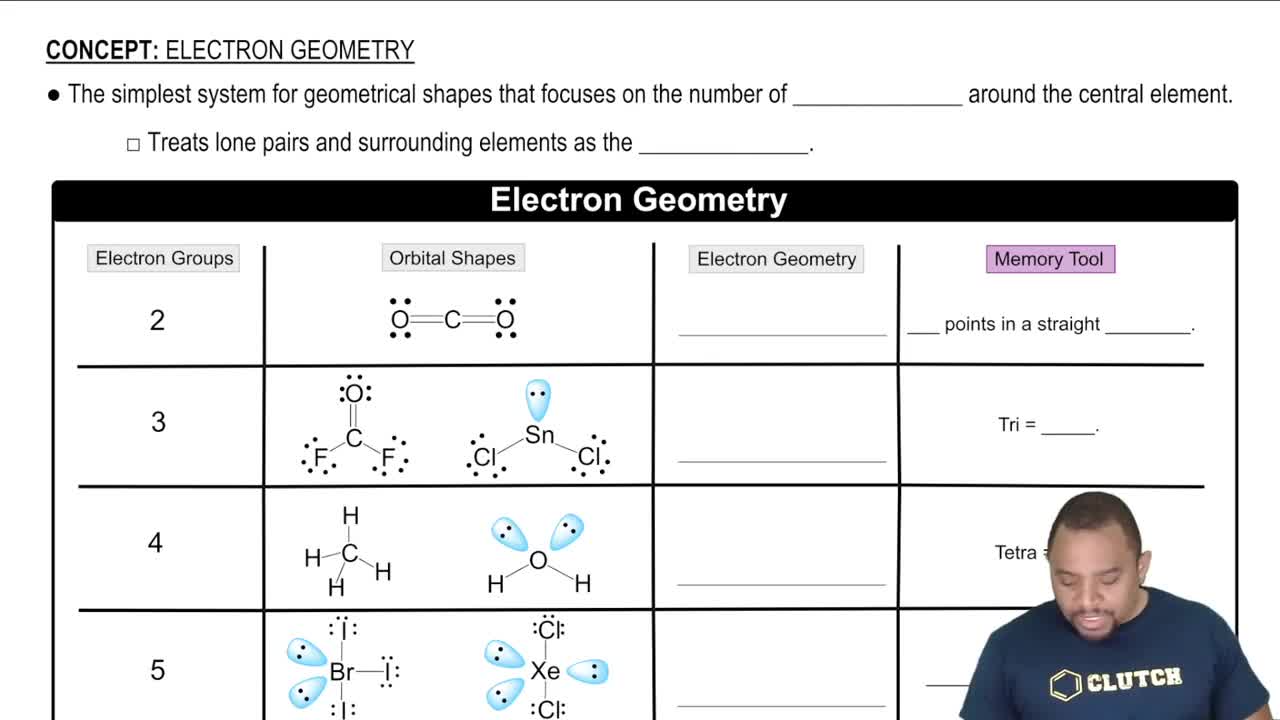
Electron Geometry
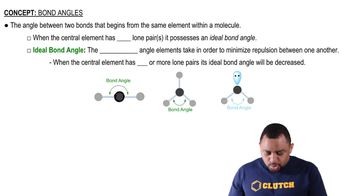
Bond Angles
Bond angles are the angles formed between two bonds that share a common atom. In the case of diamond, the bond angles between the carbon-carbon bonds are crucial for understanding its three-dimensional structure. The tetrahedral bond angles of 109.5 degrees ensure that the carbon atoms are optimally spaced, minimizing electron pair repulsion according to VSEPR theory.
추천 영상:
가이드 코스
Bond Angles
Crystal Lattice Structure
Diamond has a crystal lattice structure, which is a repeating pattern of atoms in three-dimensional space. This arrangement not only defines the bond angles but also contributes to diamond's exceptional hardness and thermal conductivity. The regularity of the lattice allows for uniform bond angles and distances, reinforcing the stability of the material.
추천 영상:
가이드 코스
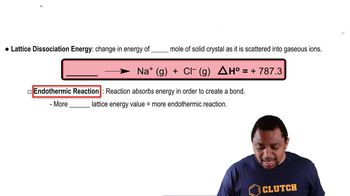
Lattice Energy
관련 실천
교과서 질문
543
views
교과서 질문
The karat scale used to describe gold alloys is based on mass percentages. (a) If an alloy is formed that is 50 mol% silver and 50 mol% gold, what is the karat number of the alloy? Use Figure 12.18 to estimate the color of this alloy.
684
views
교과서 질문
(b) What are they in graphite (in one sheet)?
교과서 질문
Employing the bond enthalpy values listed in Table 8.4, estimate the molar enthalpy change occurring upon (a) polymerization of ethylene. (b) formation of nylon 6,6. (c) formation of polyethylene terephthalate (PET).
350
views
교과서 질문
The karat scale used to describe gold alloys is based on mass percentages. (b) If an alloy is formed that is 50 mol% copper and 50 mol% gold, what is the karat number of the alloy? What is the color of this alloy?
721
views