Ch.12 - Solids and Modern Materials
Brown - Chemistry: The Central Science 14th Edition
Brown14th EditionChemistry: The Central ScienceISBN: 9780134414232당신이 사용하는 게 아니라요?교과서 변경
12장, 문제 69a

Both covalent-network solids and ionic solids can have melting points well in excess of room temperature, and both can be poor conductors of electricity in their pure form. However, in other ways their properties are quite different. (a) Which type of solid is more likely to dissolve in water?

검증된 단계별 안내
1
Identify the two types of solids mentioned: covalent-network solids and ionic solids.
Recall that ionic solids are composed of positive and negative ions held together by electrostatic forces, while covalent-network solids consist of atoms connected by covalent bonds in a continuous network.
Consider the solubility of ionic solids in water: Ionic solids tend to dissolve in water because water is a polar solvent that can stabilize the ions in solution.
Understand that covalent-network solids, such as diamond or quartz, do not dissolve in water because their atoms are held together by strong covalent bonds that are not easily broken by water molecules.
Conclude that ionic solids are more likely to dissolve in water compared to covalent-network solids.

비슷한 문제에 대한 검증된 영상 답변:

이 영상 해법은 위 문제에 도움이 된다고 튜터들이 추천한 것입니다.
영상 길이:
3m
도움이 되었나요?

주요 개념

질문에 올바르게 답하기 위해 반드시 이해해야 하는 핵심 개념들은 다음과 같습니다.

Covalent-Network Solids

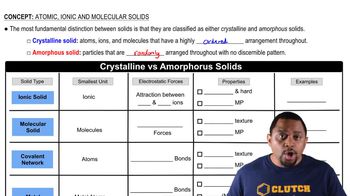
Covalent-network solids are materials where atoms are bonded together by a network of covalent bonds, forming a continuous structure. This results in very high melting points and hardness. Examples include diamond and silicon carbide. These solids typically do not dissolve in water due to their strong covalent bonds and lack of ionic character.
추천 영상:
가이드 코스
04:13
Crystalline vs Amorphous Solids

Ionic Solids

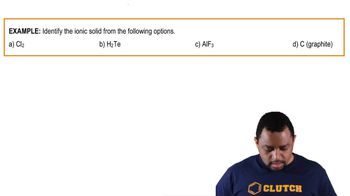
Ionic solids consist of positively and negatively charged ions held together by strong electrostatic forces known as ionic bonds. They generally have high melting points and can conduct electricity when melted or dissolved in water. Ionic solids, such as sodium chloride, are more likely to dissolve in water because the polar water molecules can effectively separate the ions.
추천 영상:
가이드 코스
00:34
Ionic Solid Identification Example

Solubility in Water

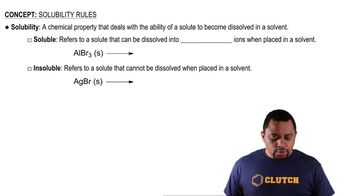
Solubility in water refers to the ability of a substance to dissolve in water, which is influenced by the nature of the solute and solvent. Polar substances tend to dissolve well in water due to interactions with water molecules, while nonpolar substances do not. Ionic solids are typically soluble in water because the attraction between water molecules and the ions overcomes the ionic bonds holding the solid together.
추천 영상:
가이드 코스
02:07
Solubility and Insolubility