Ch.12 - Solids and Modern Materials
Brown - Chemistry: The Central Science 14th Edition
Brown14th EditionChemistry: The Central ScienceISBN: 9780134414232당신이 사용하는 게 아니라요?교과서 변경
12장, 문제 73

If you want to dope GaAs to make an n-type semiconductor with an element to replace Ga, which element(s) would you pick?

검증된 단계별 안내
1
Identify the position of Gallium (Ga) in the periodic table. Ga is in group 13, which means it has 3 valence electrons.
To create an n-type semiconductor, you need to introduce an element with more valence electrons than Ga, typically from group 15, which has 5 valence electrons.
Consider elements in group 15 that can replace Ga in the GaAs lattice. These elements include Nitrogen (N), Phosphorus (P), Arsenic (As), Antimony (Sb), and Bismuth (Bi).
Choose an element from group 15 that is chemically compatible and can fit into the GaAs crystal structure. Phosphorus (P) and Arsenic (As) are common choices due to their similar atomic sizes and chemical properties.
By replacing Ga with an element from group 15, you introduce extra electrons into the structure, creating an n-type semiconductor with increased electron concentration.

비슷한 문제에 대한 검증된 영상 답변:

이 영상 해법은 위 문제에 도움이 된다고 튜터들이 추천한 것입니다.
영상 길이:
58s
도움이 되었나요?

주요 개념

질문에 올바르게 답하기 위해 반드시 이해해야 하는 핵심 개념들은 다음과 같습니다.

Doping in Semiconductors

Doping is the intentional introduction of impurities into a semiconductor to modify its electrical properties. In n-type semiconductors, elements with more valence electrons than the semiconductor material are added, providing extra electrons that enhance conductivity. For Gallium Arsenide (GaAs), which has three valence electrons from Ga and five from As, n-type doping typically involves elements from group V of the periodic table.
추천 영상:
가이드 코스
03:37
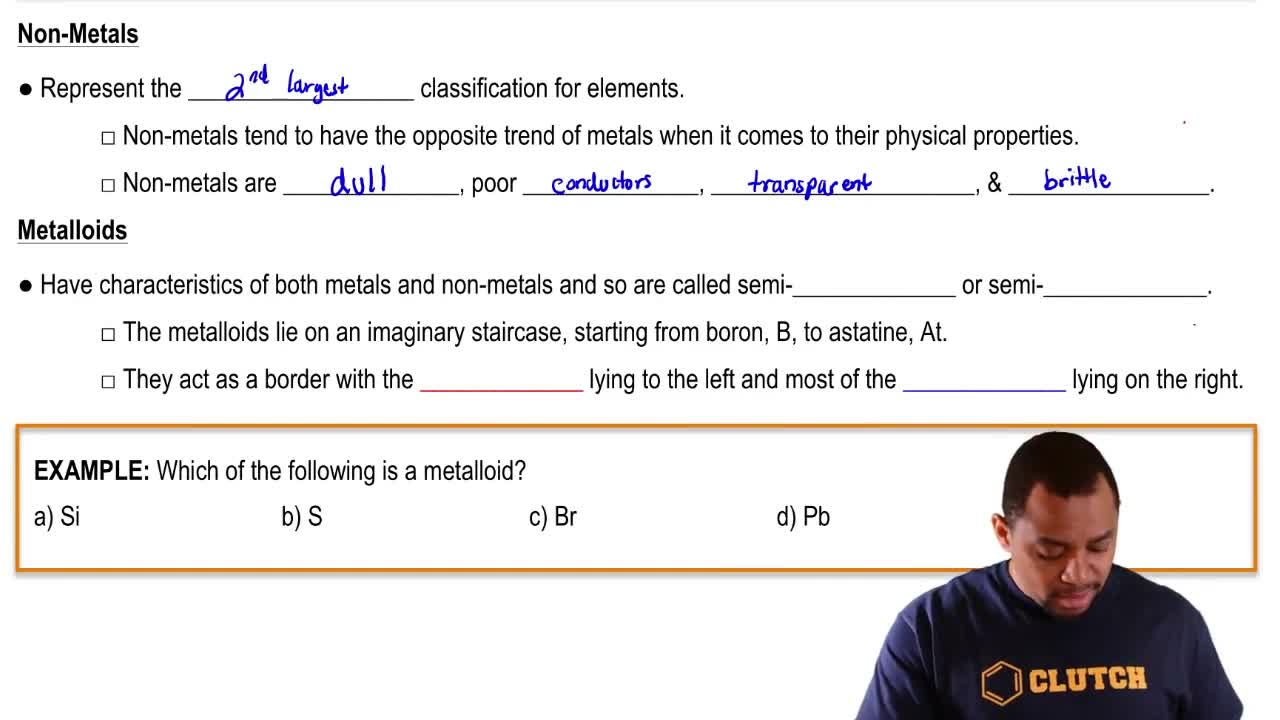
Metalloid Properties

N-type Semiconductors

N-type semiconductors are created when a semiconductor is doped with elements that have more valence electrons than the semiconductor itself, resulting in an excess of electrons. These extra electrons serve as charge carriers, increasing the material's conductivity. In the case of GaAs, suitable dopants would be elements like phosphorus (P) or arsenic (As) that can replace gallium (Ga) and contribute additional electrons.
추천 영상:
가이드 코스
01:37
Markovnikov’s Rule

Gallium Arsenide (GaAs) Structure

Gallium Arsenide (GaAs) is a compound semiconductor with a zinc-blende crystal structure, consisting of gallium (Ga) and arsenic (As) atoms. Understanding its structure is crucial for effective doping, as the arrangement of atoms influences how dopants interact with the lattice. The replacement of Ga with suitable dopants must maintain the crystal integrity while introducing the desired electrical properties.
추천 영상:
가이드 코스
01:42
Resonance Structures