Ch.12 - Solids and Modern Materials
Brown - Chemistry: The Central Science 14th Edition
Brown14th EditionChemistry: The Central ScienceISBN: 9780134414232당신이 사용하는 게 아니라요?교과서 변경
12장, 문제 68

Classify each of the following statements as true or false: (a) For molecular solids, the melting point generally increases as the strengths of the covalent bonds increase. (b) For molecular solids, the melting point generally increases as the strengths of the intermolecular forces increase.

검증된 단계별 안내
1
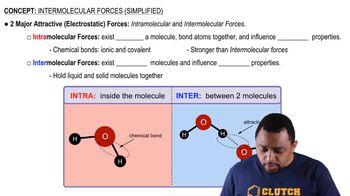
Step 1: Understand the difference between covalent bonds and intermolecular forces. Covalent bonds are the strong bonds that hold atoms together within a molecule, while intermolecular forces are weaker forces that occur between molecules.
Step 2: Analyze statement (a). In molecular solids, the molecules are held together by intermolecular forces, not covalent bonds. Therefore, the melting point is not directly related to the strength of covalent bonds within the molecules.
Step 3: Determine the truth of statement (a). Since the melting point of molecular solids is not dependent on the strength of covalent bonds, statement (a) is false.
Step 4: Analyze statement (b). The melting point of molecular solids is influenced by the strength of intermolecular forces. Stronger intermolecular forces require more energy to overcome, leading to a higher melting point.
Step 5: Determine the truth of statement (b). Since the melting point generally increases with stronger intermolecular forces, statement (b) is true.

주요 개념

질문에 올바르게 답하기 위해 반드시 이해해야 하는 핵심 개념들은 다음과 같습니다.

Molecular Solids

Molecular solids are composed of molecules held together by intermolecular forces such as van der Waals forces, dipole-dipole interactions, and hydrogen bonds. Unlike ionic or metallic solids, molecular solids have relatively lower melting and boiling points due to the weaker nature of these forces compared to covalent or ionic bonds. Understanding the structure and bonding in molecular solids is crucial for predicting their physical properties.
추천 영상:
가이드 코스
04:13
Crystalline vs Amorphous Solids

Intermolecular Forces

Intermolecular forces are the attractive forces between molecules that influence the physical properties of substances, including melting and boiling points. These forces vary in strength, with hydrogen bonds being the strongest, followed by dipole-dipole interactions and London dispersion forces. The strength of these forces directly affects the melting point of molecular solids, as stronger intermolecular forces lead to higher melting points.
추천 영상:
가이드 코스
01:59
Intermolecular vs Intramolecular Forces

Covalent Bonds vs. Intermolecular Forces

Covalent bonds are strong chemical bonds formed by the sharing of electrons between atoms, resulting in the formation of molecules. In contrast, intermolecular forces are weaker interactions that occur between molecules. While the strength of covalent bonds affects the stability of the molecules themselves, it is the strength of the intermolecular forces that primarily determines the melting point of molecular solids.
추천 영상:
가이드 코스
01:59
Intermolecular vs Intramolecular Forces