Consider the unit cells shown here for three different structures that are commonly observed for metallic elements. (b) Which structure(s) corresponds to the least dense packing of atoms?
Ch.12 - Solids and Modern Materials
12장, 문제 33a
Consider the unit cells shown here for three different structures that are commonly observed for metallic elements. (a) Which structure(s) corresponds to the densest packing of atoms?

검증된 단계별 안내1
Identify the type of unit cell for each structure: A, B, and C.
Determine the number of atoms per unit cell for each structure.
Calculate the packing efficiency for each type of unit cell.
Compare the packing efficiencies to determine which structure(s) have the densest packing.
Conclude which structure(s) correspond to the densest packing of atoms based on the highest packing efficiency.

비슷한 문제에 대한 검증된 영상 답변:
이 영상 해법은 위 문제에 도움이 된다고 튜터들이 추천한 것입니다.
영상 길이:
1m도움이 되었나요?
주요 개념
질문에 올바르게 답하기 위해 반드시 이해해야 하는 핵심 개념들은 다음과 같습니다.
Unit Cell
A unit cell is the smallest repeating unit of a crystal lattice that reflects the overall symmetry and structure of the entire crystal. It defines the arrangement of atoms in a solid and can vary in shape, such as cubic, tetragonal, or hexagonal. Understanding unit cells is crucial for analyzing the packing efficiency and density of different crystalline structures.
추천 영상:
가이드 코스
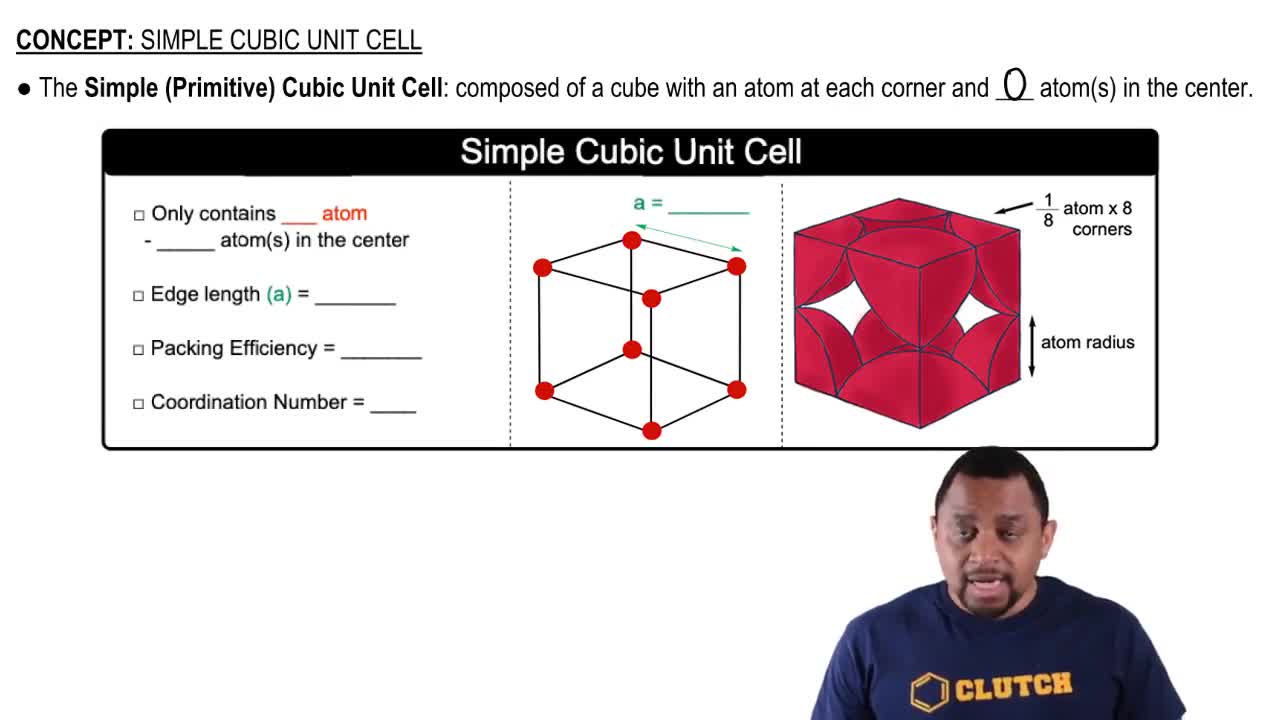
Simple Cubic Unit Cell
Atomic Packing Efficiency
Atomic packing efficiency (APE) refers to the fraction of volume in a crystal structure that is occupied by atoms. It is calculated by comparing the volume occupied by the atoms to the total volume of the unit cell. Higher packing efficiency indicates a denser arrangement of atoms, which is important for understanding the physical properties of metals and their stability.
추천 영상:
가이드 코스
Atom Structure
Close-Packed Structures
Close-packed structures, such as face-centered cubic (FCC) and hexagonal close-packed (HCP), are arrangements where atoms are packed together as closely as possible. These structures maximize atomic density and are characterized by specific coordination numbers and packing efficiencies. Identifying these structures is essential for determining which metallic arrangements provide the densest packing.
추천 영상:
가이드 코스
Resonance Structures
관련 실천
교과서 질문
454
views
교과서 질문
Sodium metal (atomic weight 22.99 g/mol) adopts a body-centered cubic structure with a density of 0.97 g/cm3. (a) Use this information and Avogadro’s number (NA = 6.022 × 10²³/mol) to estimate the atomic radius of sodium. (b) If sodium didn't react so vigorously, it could float on water. Use the answer from part (a) to estimate the density of Na if its structure were that of a cubic close-packed metal. Would it still float on water?
1701
views
1
comments
교과서 질문
The unit cell of a compound containing potassium, aluminum, and fluorine is shown here. (a) What type of lattice does this crystal possess (all three lattice vectors are mutually perpendicular)?
531
views