Ch.12 - Solids and Modern Materials
Brown - Chemistry: The Central Science 14th Edition
Brown14th EditionChemistry: The Central ScienceISBN: 9780134414232당신이 사용하는 게 아니라요?교과서 변경
12장, 문제 34

Sodium metal (atomic weight 22.99 g/mol) adopts a body-centered cubic structure with a density of 0.97 g/cm3. (a) Use this information and Avogadro’s number (NA = 6.022 × 10²³/mol) to estimate the atomic radius of sodium. (b) If sodium didn't react so vigorously, it could float on water. Use the answer from part (a) to estimate the density of Na if its structure were that of a cubic close-packed metal. Would it still float on water?

검증된 단계별 안내
1
Identify the type of crystal structure for cubic close-packed (ccp), which is also known as face-centered cubic (fcc).
Recall that in a face-centered cubic structure, there are 4 atoms per unit cell.
Use the formula for density: \( \text{Density} = \frac{\text{Mass of atoms in unit cell}}{\text{Volume of unit cell}} \).
Calculate the mass of the atoms in the unit cell using the atomic weight of sodium and Avogadro's number.
Estimate the volume of the unit cell using the relationship between the atomic radius and the edge length in a face-centered cubic structure, then calculate the density and compare it to the density of water (1 g/cm³) to determine if it would float.

비슷한 문제에 대한 검증된 영상 답변:

이 영상 해법은 위 문제에 도움이 된다고 튜터들이 추천한 것입니다.
영상 길이:
6m
도움이 되었나요?

주요 개념

질문에 올바르게 답하기 위해 반드시 이해해야 하는 핵심 개념들은 다음과 같습니다.

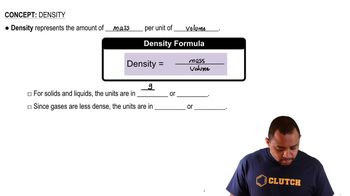
Density

Density is defined as mass per unit volume, typically expressed in grams per cubic centimeter (g/cm³). It is a crucial property that determines whether a substance will float or sink in a fluid. In this context, understanding the density of sodium in different crystal structures helps assess its buoyancy in water.
추천 영상:
가이드 코스
01:56
Density Concepts

Crystal Structures

Crystal structures refer to the orderly arrangement of atoms in a solid. The body-centered cubic (BCC) and cubic close-packed (CCP) structures are two common types. The arrangement affects the packing efficiency and, consequently, the density of the material, which is essential for estimating how sodium would behave in water.
추천 영상:
가이드 코스
01:42
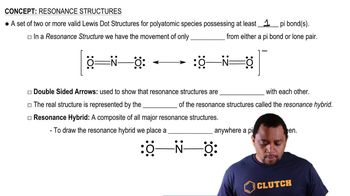
Resonance Structures

Buoyancy

Buoyancy is the upward force exerted by a fluid that opposes the weight of an object immersed in it. An object will float if its density is less than that of the fluid. In this case, determining whether sodium would float on water involves comparing its estimated density in a cubic close-packed structure to the density of water (1 g/cm³).