Ch.12 - Solids and Modern Materials
Brown - Chemistry: The Central Science 14th Edition
Brown14th EditionChemistry: The Central ScienceISBN: 9780134414232당신이 사용하는 게 아니라요?교과서 변경
12장, 문제 45c

Indicate whether each statement is true or false: (c) Nonmetallic elements are never found in alloys.

검증된 단계별 안내
1
Understand the definition of an alloy: An alloy is a mixture of metals or a mixture of a metal and another element.
Recognize that nonmetallic elements can be part of an alloy: Nonmetallic elements such as carbon, silicon, phosphorus, and others can be incorporated into alloys to enhance their properties.
Consider common examples: Steel is an alloy of iron and carbon, where carbon is a nonmetallic element.
Analyze the statement: The statement claims that nonmetallic elements are never found in alloys, which contradicts the examples where nonmetallic elements are indeed part of alloys.
Conclude the truth value: Based on the understanding and examples, determine whether the statement is true or false.

비슷한 문제에 대한 검증된 영상 답변:

이 영상 해법은 위 문제에 도움이 된다고 튜터들이 추천한 것입니다.
영상 길이:
1m
도움이 되었나요?

주요 개념

질문에 올바르게 답하기 위해 반드시 이해해야 하는 핵심 개념들은 다음과 같습니다.

Nonmetals and Alloys

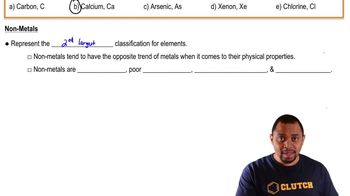
Nonmetals are elements that typically lack the properties of metals, such as conductivity and malleability. Alloys are mixtures of two or more elements, where at least one is a metal. While nonmetals are not commonly found in traditional metallic alloys, they can be present in certain specialized alloys, such as those used in semiconductors or specific chemical applications.
추천 영상:
가이드 코스
01:12
Nonmetal Properties

Properties of Alloys

Alloys are designed to enhance specific properties such as strength, corrosion resistance, or ductility. The inclusion of nonmetals can modify these properties, leading to improved performance in certain applications. For example, carbon is a nonmetal that is a key component in steel, significantly increasing its strength.
추천 영상:
가이드 코스
02:54
Physical Properties

True or False Statements in Chemistry

In chemistry, evaluating statements as true or false often requires understanding the definitions and characteristics of the elements or compounds involved. This involves critical thinking and knowledge of chemical principles, such as the behavior of nonmetals and their interactions with metals in various contexts, including alloys.
추천 영상:
가이드 코스
01:29
Introduction to Organic Chemistry Example