
Ch.12 - Solids and Modern Materials
Brown - Chemistry: The Central Science 14th Edition
Brown14th EditionChemistry: The Central ScienceISBN: 9780134414232당신이 사용하는 게 아니라요?교과서 변경
12장, 문제 131d

One method to synthesize ionic solids is by the heating of two reactants at high temperatures. Consider the reaction of FeO with TiO2 to form FeTiO3. Determine the amount of each of the two reactants to prepare 2.500 g FeTiO3, assuming the reaction goes to completion. (d) Determine moles and mass (g) of FeO required.

검증된 단계별 안내
1
\[ \text{FeO} + \text{TiO}_2 \rightarrow \text{FeTiO}_3 \]

비슷한 문제에 대한 검증된 영상 답변:

이 영상 해법은 위 문제에 도움이 된다고 튜터들이 추천한 것입니다.
영상 길이:
5m
도움이 되었나요?

주요 개념

질문에 올바르게 답하기 위해 반드시 이해해야 하는 핵심 개념들은 다음과 같습니다.

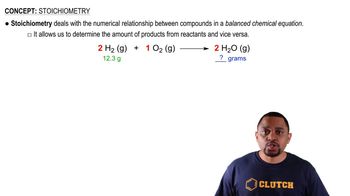
Stoichiometry

Stoichiometry is the calculation of reactants and products in chemical reactions based on the balanced chemical equation. It allows chemists to determine the proportions of substances involved in a reaction, which is essential for predicting how much of each reactant is needed to produce a desired amount of product.
추천 영상:
가이드 코스
01:16
Stoichiometry Concept

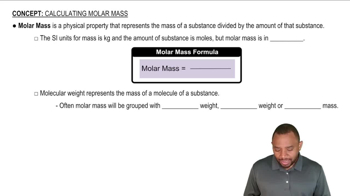
Molar Mass

Molar mass is the mass of one mole of a substance, typically expressed in grams per mole (g/mol). It is crucial for converting between the mass of a substance and the number of moles, enabling the calculation of how much of each reactant is required to achieve a specific mass of product in a chemical reaction.
추천 영상:
가이드 코스
02:11
Molar Mass Concept

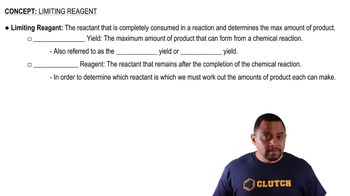
Limiting Reactant

The limiting reactant is the substance that is completely consumed first in a chemical reaction, thus determining the maximum amount of product that can be formed. Identifying the limiting reactant is essential for accurate stoichiometric calculations, as it influences the amounts of other reactants needed and the yield of the product.
추천 영상:
가이드 코스
01:30
Limiting Reagent Concept