Ch.12 - Solids and Modern Materials
Brown - Chemistry: The Central Science 14th Edition
Brown14th EditionChemistry: The Central ScienceISBN: 9780134414232당신이 사용하는 게 아니라요?교과서 변경
12장, 문제 14d

Which type (or types) of crystalline solid is characterized by each of the following? (d) network of covalent bonds.

검증된 단계별 안내
1
Identify the key characteristic of the crystalline solid mentioned in the problem, which is a 'network of covalent bonds'.
Understand that a network of covalent bonds in a solid implies that the atoms are bonded in a continuous network across the entire structure, rather than being isolated molecules or ions.
Recall the four main types of crystalline solids: molecular, ionic, metallic, and covalent network.
Analyze which type of crystalline solid typically features a continuous network of covalent bonds. This type of solid is characterized by strong, directional covalent bonds that extend throughout the material, forming a rigid structure.
Conclude that the type of crystalline solid characterized by a network of covalent bonds is known as a 'covalent network solid'.

비슷한 문제에 대한 검증된 영상 답변:

이 영상 해법은 위 문제에 도움이 된다고 튜터들이 추천한 것입니다.
영상 길이:
2m
도움이 되었나요?

주요 개념

질문에 올바르게 답하기 위해 반드시 이해해야 하는 핵심 개념들은 다음과 같습니다.

Covalent Network Solids

Covalent network solids are a type of crystalline solid where atoms are connected by a continuous network of covalent bonds. This structure results in materials that are typically very hard, have high melting points, and are poor conductors of electricity. Examples include diamond and silicon carbide, which exhibit exceptional strength and stability due to their extensive bonding.
추천 영상:
가이드 코스
04:13
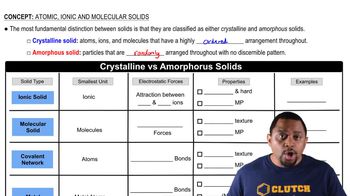
Crystalline vs Amorphous Solids

Crystalline Solids

Crystalline solids are materials whose constituents, such as atoms or molecules, are arranged in an orderly repeating pattern extending in all three spatial dimensions. This regular arrangement leads to distinct geometric shapes and well-defined melting points. Crystalline solids can be classified into various types, including ionic, covalent, metallic, and molecular solids, each with unique properties.
추천 영상:
가이드 코스
01:31
Crystalline Solids Structure

Bonding Types in Solids

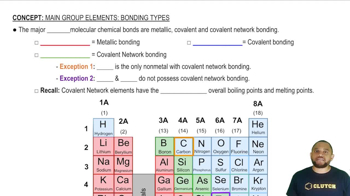
The type of bonding in solids significantly influences their physical properties. In covalent network solids, strong covalent bonds create a rigid structure, while ionic solids are held together by electrostatic forces between charged ions. Understanding these bonding types helps predict the behavior of materials under different conditions, such as temperature and pressure, and their suitability for various applications.
추천 영상: