Ch.12 - Solids and Modern Materials
Brown - Chemistry: The Central Science 14th Edition
Brown14th EditionChemistry: The Central ScienceISBN: 9780134414232당신이 사용하는 게 아니라요?교과서 변경
12장, 문제 14b

Which type (or types) of crystalline solid is characterized by each of the following? (b) softness, relatively low melting point;

검증된 단계별 안내
1
Identify the characteristics given in the problem: softness and relatively low melting point.
Recall the four main types of crystalline solids: ionic, molecular, covalent network, and metallic.
Analyze each type: Ionic solids typically have high melting points; metallic solids are malleable but not typically soft; covalent network solids are very hard and have high melting points.
Focus on molecular solids, which are generally composed of molecules held together by intermolecular forces such as London dispersion forces, dipole-dipole interactions, or hydrogen bonds.
Conclude that molecular solids best fit the description as they are characterized by softness and relatively low melting points due to the weaker intermolecular forces compared to other types of crystalline solids.

비슷한 문제에 대한 검증된 영상 답변:

이 영상 해법은 위 문제에 도움이 된다고 튜터들이 추천한 것입니다.
영상 길이:
2m
도움이 되었나요?

주요 개념

질문에 올바르게 답하기 위해 반드시 이해해야 하는 핵심 개념들은 다음과 같습니다.

Types of Crystalline Solids

Crystalline solids can be categorized into several types based on the nature of the bonding and the arrangement of their constituent particles. The main types include ionic, covalent network, metallic, and molecular solids. Each type exhibits distinct physical properties, such as hardness, melting point, and conductivity, which are influenced by the strength and type of interactions between the particles.
추천 영상:
가이드 코스
01:31
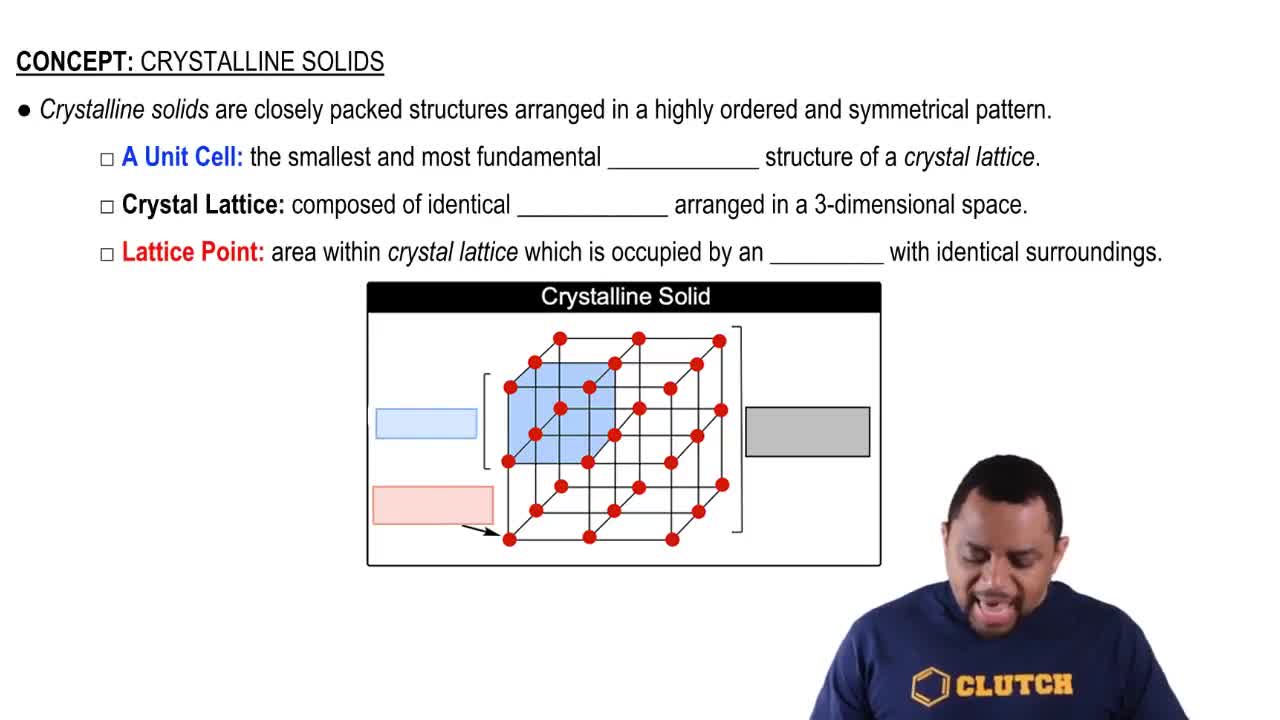
Crystalline Solids Structure

Molecular Solids

Molecular solids are composed of molecules held together by relatively weak intermolecular forces, such as van der Waals forces or hydrogen bonds. This type of solid typically exhibits characteristics like softness and low melting points, as the forces holding the molecules together are not as strong as those in ionic or covalent solids. Examples include ice and sugar, which can be easily deformed and melt at lower temperatures.
추천 영상:
가이드 코스
04:13
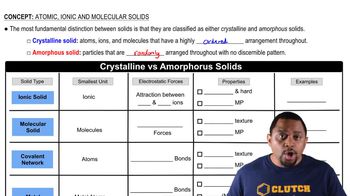
Crystalline vs Amorphous Solids

Melting Point and Softness

The melting point of a solid is the temperature at which it transitions from a solid to a liquid state. Softness refers to the ability of a material to be easily deformed or scratched. In crystalline solids, those with lower melting points and softness, such as molecular solids, often have weaker bonding forces, making them more susceptible to changes in temperature and pressure compared to harder solids like ionic or covalent network solids.
추천 영상:
가이드 코스
04:29
Boiling Point and Melting Point