Ch.12 - Solids and Modern Materials
Brown - Chemistry: The Central Science 14th Edition
Brown14th EditionChemistry: The Central ScienceISBN: 9780134414232당신이 사용하는 게 아니라요?교과서 변경
12장, 문제 53

Which would you expect to be the more ductile element, (a) Ag or Mo? (b) Zn or Si? In each case explain your reasoning.

검증된 단계별 안내
1
Identify the crystal structures of Ag (Silver) and Mo (Molybdenum). Silver typically crystallizes in a face-centered cubic (FCC) structure, while Molybdenum crystallizes in a body-centered cubic (BCC) structure.
Understand the implications of these crystal structures on ductility. FCC structures, like that of Silver, generally allow for easier slip because they have a higher number of slip systems (12 {111}<110> slip systems). This is due to the close packing and multiple slip planes available in the FCC structure.
Compare this to the BCC structure of Molybdenum, which has fewer slip systems (48 {110}<111>, {112}<111>, and {123}<111> slip systems) and generally experiences more resistance to dislocation motion, especially at lower temperatures, making it less ductile.
Consider the electronic configuration and bonding. Silver, being a noble metal with a single electron in the outermost s-orbital, has more metallic character and greater malleability and ductility. Molybdenum, a transition metal, has partially filled d orbitals that contribute to stronger, more directional bonding, reducing its ductility.
Conclude that based on the crystal structure and electronic properties, Silver (Ag) is expected to be more ductile than Molybdenum (Mo).

비슷한 문제에 대한 검증된 영상 답변:

이 영상 해법은 위 문제에 도움이 된다고 튜터들이 추천한 것입니다.
영상 길이:
3m
도움이 되었나요?

주요 개념

질문에 올바르게 답하기 위해 반드시 이해해야 하는 핵심 개념들은 다음과 같습니다.

Ductility

Ductility is a measure of a material's ability to deform under tensile stress, which is often characterized by the material's ability to be stretched into a wire. Metals typically exhibit high ductility due to the presence of metallic bonds that allow atoms to slide past one another without breaking the overall structure. This property is crucial in applications where materials need to be shaped or drawn into wires.

Metallic Bonding

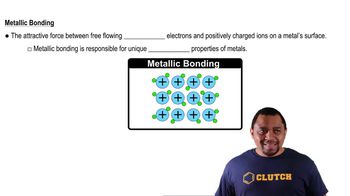
Metallic bonding is a type of chemical bonding that occurs between metal atoms, characterized by a 'sea of electrons' that are free to move around. This delocalization of electrons allows metals to conduct electricity and heat efficiently, as well as contributing to their malleability and ductility. The strength and nature of these bonds can vary between different metals, influencing their physical properties.
추천 영상:

Comparison of Silver (Ag) and Molybdenum (Mo)

Silver (Ag) is known for its high ductility and malleability, making it one of the most ductile metals. In contrast, Molybdenum (Mo) is a transition metal that, while strong and resistant to heat, is less ductile than silver. The differences in their atomic structure and bonding lead to silver being more easily drawn into wires compared to molybdenum, which is more brittle.
추천 영상:
가이드 코스
02:11
Bond Order and Type of Bond Example
관련 실천