
Ch.13 - Properties of Solutions
Brown - Chemistry: The Central Science 14th Edition
Brown14th EditionChemistry: The Central ScienceISBN: 9780134414232당신이 사용하는 게 아니라요?교과서 변경
13장, 문제 98c

Acetonitrile (CH3CN) is a polar organic solvent that dissolves a wide range of solutes, including many salts. The density of a 1.80 M LiBr solution in acetonitrile is 0.826 g/cm3. Calculate the concentration of the solution in (c) mass percentage of CH3CN.

검증된 단계별 안내
1
First, understand that mass percentage is calculated as the mass of the solute divided by the total mass of the solution, multiplied by 100%. In this case, we need to find the mass percentage of CH3CN in the solution.
Calculate the molar mass of LiBr. Lithium (Li) has an atomic mass of approximately 6.94 g/mol, and bromine (Br) has an atomic mass of approximately 79.90 g/mol. Add these values to find the molar mass of LiBr.
Use the molarity of the solution to find the mass of LiBr in 1 liter of solution. Since the solution is 1.80 M, this means there are 1.80 moles of LiBr per liter. Multiply the number of moles by the molar mass of LiBr to find the mass of LiBr in grams.
Calculate the total mass of the solution. Use the density of the solution (0.826 g/cm³) to find the mass of 1 liter of solution. Since 1 liter is 1000 cm³, multiply the density by 1000 cm³ to find the total mass of the solution in grams.
Subtract the mass of LiBr from the total mass of the solution to find the mass of CH3CN. Then, calculate the mass percentage of CH3CN by dividing the mass of CH3CN by the total mass of the solution and multiplying by 100%.

비슷한 문제에 대한 검증된 영상 답변:

이 영상 해법은 위 문제에 도움이 된다고 튜터들이 추천한 것입니다.
영상 길이:
4m
도움이 되었나요?

주요 개념

질문에 올바르게 답하기 위해 반드시 이해해야 하는 핵심 개념들은 다음과 같습니다.

Molarity and Concentration

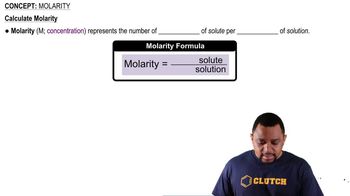
Molarity (M) is a measure of concentration defined as the number of moles of solute per liter of solution. In this case, a 1.80 M LiBr solution indicates that there are 1.80 moles of lithium bromide dissolved in one liter of acetonitrile. Understanding molarity is essential for converting between moles and mass when calculating mass percentages.
추천 영상:
가이드 코스
00:53
Molarity Concept

Mass Percentage

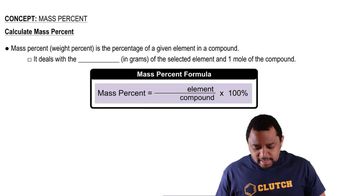
Mass percentage is a way to express the concentration of a component in a mixture, calculated as the mass of the component divided by the total mass of the solution, multiplied by 100. To find the mass percentage of acetonitrile in the solution, one must determine the mass of acetonitrile and the total mass of the solution, which includes both the solute and the solvent.
추천 영상:
가이드 코스
00:38
Mass Percent Calculation

Density and Volume Relationships

Density is defined as mass per unit volume (g/cm³). In this problem, the density of the solution allows for the conversion between mass and volume. By knowing the density of the 1.80 M LiBr solution, one can calculate the total mass of the solution, which is necessary for determining the mass percentage of acetonitrile.
추천 영상:
가이드 코스
01:09
Relationship of Volume and Moles Example
관련 실천
교과서 질문

Acetonitrile (CH3CN) is a polar organic solvent that dissolves a wide range of solutes, including many salts. The density of a 1.80 M LiBr solution in acetonitrile is 0.826 g/cm3. Calculate the concentration of the solution in (a) molality,

630
views
교과서 질문
A 'canned heat' product used to warm buffet dishes consists of a homogeneous mixture of ethanol 1C2H5OH2 and paraffin, which has an average formula of C24H50. What mass of C2H5OH should be added to 620 kg of the paraffin to produce 8 torr of ethanol vapor pressure at 35 °C? The vapor pressure of pure ethanol at 35 °C is 100 torr.
693
views
교과서 질문

Acetonitrile (CH3CN) is a polar organic solvent that dissolves a wide range of solutes, including many salts. The density of a 1.80 M LiBr solution in acetonitrile is 0.826 g/cm3. Calculate the concentration of the solution in (b) mole fraction of LiBr,

820
views
교과서 질문

Two beakers are placed in a sealed box at 25 °C. One beaker contains 30.0 mL of a 0.050 M aqueous solution of a nonvolatile nonelectrolyte. The other beaker contains 30.0 mL of a 0.035 M aqueous solution of NaCl. The water vapor from the two solutions reaches equilibrium. (a) In which beaker does the solution level rise, and in which one does it fall?

580
views
교과서 질문

Two beakers are placed in a sealed box at 25 °C. One beaker contains 30.0 mL of a 0.050 M aqueous solution of a nonvolatile nonelectrolyte. The other beaker contains 30.0 mL of a 0.035 M aqueous solution of NaCl. The water vapor from the two solutions reaches equilibrium. (b) What are the volumes in the two beakers when equilibrium is attained, assuming ideal behavior?

812
views
교과서 질문

The maximum allowable concentration of lead in drinking water is 9.0 ppb. (b) How many grams of lead are in a swimming pool containing 9.0 ppb lead in 60 m3 of water?

1826
views