
Carbon disulfide (CS2) boils at 46.30 °C and has a density of 1.261 g/mL. (a) When 0.250 mol of a nondissociating solute is dissolved in 400.0 mL of CS2, the solution boils at 47.46 °C. What is the molal boiling-point-elevation constant for CS2?
Ch.13 - Properties of Solutions
13장, 문제 101b
Two beakers are placed in a sealed box at 25 °C. One beaker contains 30.0 mL of a 0.050 M aqueous solution of a nonvolatile nonelectrolyte. The other beaker contains 30.0 mL of a 0.035 M aqueous solution of NaCl. The water vapor from the two solutions reaches equilibrium. (b) What are the volumes in the two beakers when equilibrium is attained, assuming ideal behavior?
검증된 단계별 안내1
Identify the solute in each beaker: the first beaker contains a nonvolatile nonelectrolyte, and the second beaker contains NaCl, which is an electrolyte.
Recognize that the nonvolatile nonelectrolyte does not dissociate in solution, so its concentration remains 0.050 M.
Understand that NaCl dissociates into Na⁺ and Cl⁻ ions in solution, effectively doubling the concentration of particles in the solution to 0.070 M (0.035 M Na⁺ + 0.035 M Cl⁻).
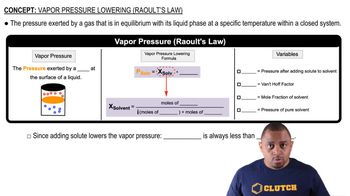
Apply Raoult's Law to determine the vapor pressure lowering for each solution. The vapor pressure lowering is proportional to the mole fraction of solute particles in each solution.
Assume that the total volume of water in the system remains constant and that the vapor pressures of the solutions equalize at equilibrium, allowing you to set up an equation to solve for the final volumes in each beaker.

비슷한 문제에 대한 검증된 영상 답변:
이 영상 해법은 위 문제에 도움이 된다고 튜터들이 추천한 것입니다.
영상 길이:
3m주요 개념
질문에 올바르게 답하기 위해 반드시 이해해야 하는 핵심 개념들은 다음과 같습니다.
Raoult's Law
Raoult's Law states that the vapor pressure of a solvent above a solution is directly proportional to the mole fraction of the solvent in the solution. This principle is crucial for understanding how the presence of solutes, such as a nonvolatile nonelectrolyte or an electrolyte like NaCl, affects the vapor pressure and, consequently, the equilibrium state of the system.
추천 영상:
가이드 코스
Raoult's Law and Vapor Pressure
Colligative Properties
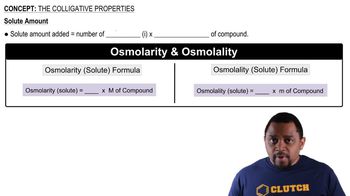
Colligative properties are properties of solutions that depend on the number of solute particles in a given amount of solvent, rather than the identity of the solute. These properties include vapor pressure lowering, boiling point elevation, freezing point depression, and osmotic pressure, which are essential for predicting how the two solutions will behave when they reach equilibrium.
추천 영상:
가이드 코스
Colligative Properties
Ideal Solution Behavior
Ideal solution behavior refers to the assumption that the interactions between different molecules in a solution are similar to those between the molecules of the pure components. This concept simplifies calculations in chemistry, allowing us to use Raoult's Law and other principles to predict the behavior of solutions under the assumption that they do not deviate significantly from ideality.
추천 영상:
가이드 코스
Ideal Gas Law Formula
관련 실천
교과서 질문
1038
views
1
rank
교과서 질문
A 'canned heat' product used to warm buffet dishes consists of a homogeneous mixture of ethanol 1C2H5OH2 and
paraffin, which has an average formula of C24H50. What
mass of C2H5OH should be added to 620 kg of the paraffin
to produce 8 torr of ethanol vapor pressure at 35 °C? The
vapor pressure of pure ethanol at 35 °C is 100 torr.
693
views
교과서 질문
Two beakers are placed in a sealed box at 25 °C. One beaker contains 30.0 mL of a 0.050 M aqueous solution of a nonvolatile nonelectrolyte. The other beaker contains 30.0 mL of a 0.035 M aqueous solution of NaCl. The water vapor from the two solutions reaches equilibrium. (a) In which beaker does the solution level rise, and in which one does it fall?
580
views
교과서 질문
Acetonitrile (CH3CN) is a polar organic solvent that dissolves a wide range of solutes, including many salts. The density of a 1.80 M LiBr solution in acetonitrile is 0.826 g/cm3. Calculate the concentration of the solution in (c) mass percentage of CH3CN.
