
Ch.13 - Properties of Solutions
Brown - Chemistry: The Central Science 14th Edition
Brown14th EditionChemistry: The Central ScienceISBN: 9780134414232당신이 사용하는 게 아니라요?교과서 변경
13장, 문제 103

Calculate the freezing point of a 0.100 m aqueous solution of K2SO4, (a) ignoring interionic attractions, and (b) taking interionic attractions into consideration by using the van’t Hoff factor (Table 13.4).

검증된 단계별 안내
1
Step 1: Identify the formula for freezing point depression, which is \( \Delta T_f = i \cdot K_f \cdot m \), where \( \Delta T_f \) is the freezing point depression, \( i \) is the van’t Hoff factor, \( K_f \) is the cryoscopic constant of the solvent (water in this case), and \( m \) is the molality of the solution.
Step 2: For part (a), calculate the freezing point depression ignoring interionic attractions. Assume \( i = 1 \) since interionic attractions are ignored. Use the given molality \( m = 0.100 \) m and the known \( K_f \) for water, which is approximately 1.86 °C/m.
Step 3: Calculate the freezing point depression \( \Delta T_f \) using the formula from Step 1 with \( i = 1 \). Substitute the values into the equation: \( \Delta T_f = 1 \cdot 1.86 \cdot 0.100 \).
Step 4: For part (b), consider interionic attractions by using the van’t Hoff factor for \( K_2SO_4 \). When \( K_2SO_4 \) dissociates in water, it forms 2 \( K^+ \) ions and 1 \( SO_4^{2-} \) ion, so \( i \) is approximately 3.
Step 5: Calculate the freezing point depression \( \Delta T_f \) using the formula from Step 1 with \( i = 3 \). Substitute the values into the equation: \( \Delta T_f = 3 \cdot 1.86 \cdot 0.100 \).

주요 개념

질문에 올바르게 답하기 위해 반드시 이해해야 하는 핵심 개념들은 다음과 같습니다.

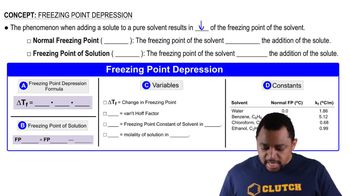
Freezing Point Depression

Freezing point depression is a colligative property that describes how the freezing point of a solvent decreases when a solute is added. The extent of this depression is directly proportional to the number of solute particles in the solution. This phenomenon occurs because solute particles disrupt the formation of the solid structure of the solvent, requiring a lower temperature to achieve freezing.
추천 영상:
가이드 코스
01:59
Freezing Point Depression

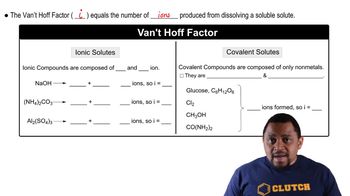
Van't Hoff Factor (i)

The van't Hoff factor (i) quantifies the effect of solute particles on colligative properties. It represents the number of particles into which a solute dissociates in solution. For example, K2SO4 dissociates into three ions (2 K+ and 1 SO4^2-), giving it a van't Hoff factor of 3. This factor is crucial for accurately calculating changes in properties like freezing point when considering ionic compounds.
추천 영상:
가이드 코스
02:50
Van't Hoff Factor

Interionic Attractions

Interionic attractions refer to the electrostatic forces between charged ions in a solution. These attractions can affect the behavior of ions in solution, particularly in terms of their effective concentration and interactions. When calculating colligative properties, ignoring these attractions simplifies the model, but including them provides a more accurate representation of the solution's behavior, especially in concentrated solutions.
추천 영상:
가이드 코스
01:49
Cell Notation Example