Indicate the principal type of solute–solvent interaction in each of the following solutions and rank the solutions from weakest to strongest solute–solvent interaction: (b) CH2Cl2 in benzene (C6H6)
Ch.13 - Properties of Solutions
13장, 문제 15c
Indicate the type of solute–solvent interaction (Section 11.2) that should be most important in each of the following solutions: (c) KBr in water
검증된 단계별 안내1
Step 1: Identify the solute and the solvent. In this case, KBr is the solute and water is the solvent.
Step 2: Determine the type of bonding in the solute. KBr is an ionic compound, which means it is made up of positive and negative ions.
Step 3: Determine the type of bonding in the solvent. Water is a polar molecule, which means it has a positive and a negative end.
Step 4: Based on the types of bonding in the solute and solvent, determine the type of solute-solvent interaction. In this case, the positive ions in KBr will be attracted to the negative ends of the water molecules, and the negative ions in KBr will be attracted to the positive ends of the water molecules.
Step 5: The type of solute-solvent interaction in this solution is ion-dipole interaction. This is because the ionic solute (KBr) interacts with the polar solvent (water) through attractions between the ions and the polar molecules.

비슷한 문제에 대한 검증된 영상 답변:
이 영상 해법은 위 문제에 도움이 된다고 튜터들이 추천한 것입니다.
영상 길이:
1m도움이 되었나요?
주요 개념
질문에 올바르게 답하기 위해 반드시 이해해야 하는 핵심 개념들은 다음과 같습니다.
Ionic Compounds and Solubility
Ionic compounds, like KBr, consist of positively and negatively charged ions. When dissolved in water, these ions separate and interact with water molecules. The solubility of ionic compounds in water is largely determined by the strength of the interactions between the ions and the polar water molecules.
추천 영상:
가이드 코스
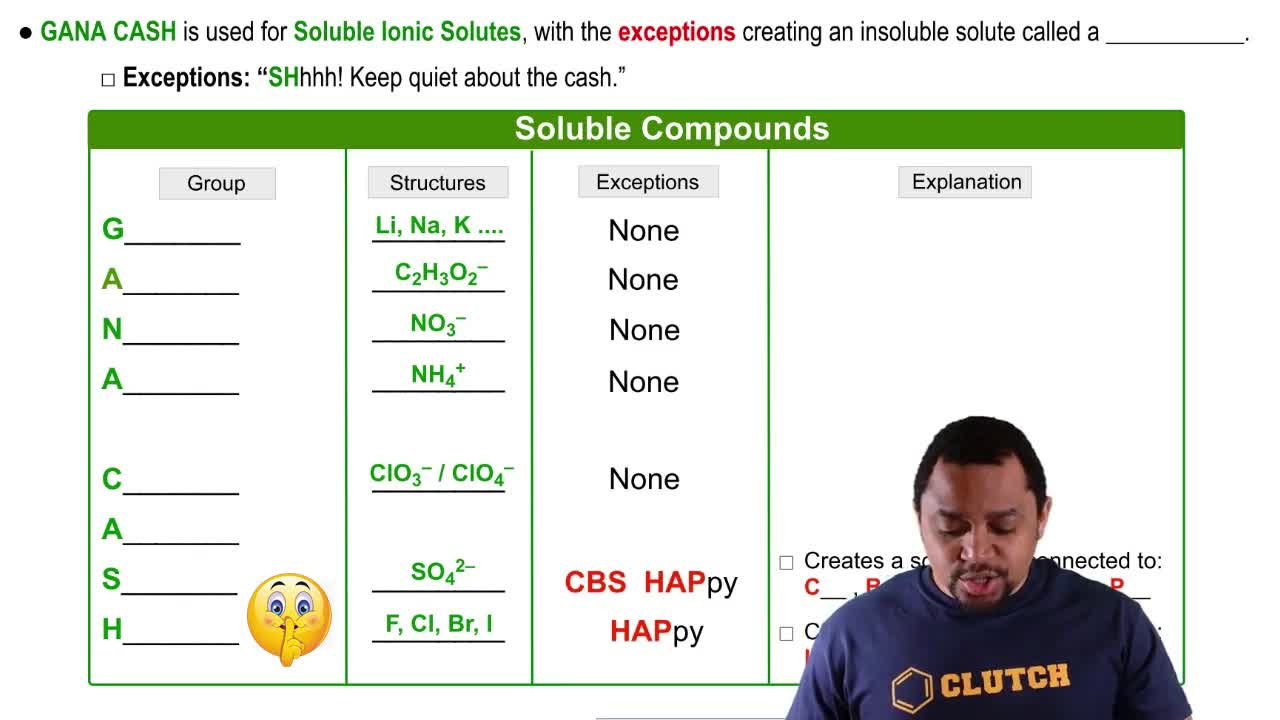
Soluble Ionic Solutes
Solute-Solvent Interactions
Solute-solvent interactions refer to the forces that occur between solute particles and solvent molecules. In the case of KBr in water, the primary interaction is ion-dipole forces, where the polar water molecules surround and stabilize the K+ and Br- ions, facilitating their dissolution.
추천 영상:
가이드 코스
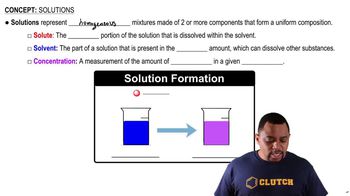
Solution Components
Hydration Shell
A hydration shell is formed when water molecules surround and interact with dissolved ions. For KBr, the K+ ions attract the oxygen end of water molecules, while the Br- ions attract the hydrogen ends. This arrangement helps to keep the ions in solution and is crucial for understanding the solubility of ionic compounds in polar solvents like water.
추천 영상:
가이드 코스
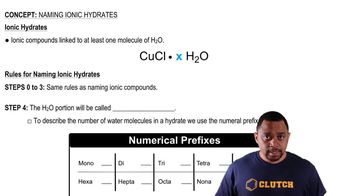
Ionic Hydrates Naming
관련 실천
교과서 질문
589
views
교과서 질문
Indicate the type of solute–solvent interaction (Section 11.2) that should be most important in each of the following solutions: (b) methanol (CH3OH) in water
966
views
교과서 질문
Indicate the principal type of solute–solvent interaction in each of the following solutions and rank the solutions from weakest to strongest solute–solvent interaction: (a) KCl in water
1508
views
교과서 질문
Indicate the type of solute–solvent interaction (Section 11.2) that should be most important in each of the following solutions: (a) CCl4 in benzene
882
views
교과서 질문
Indicate the type of solute–solvent interaction (Section 11.2) that should be most important in each of the following solutions: (d) HCl in acetonitrile (CH3CN)
759
views