Ch.14 - Chemical Kinetics
Brown - Chemistry: The Central Science 14th Edition
Brown14th EditionChemistry: The Central ScienceISBN: 9780134414232당신이 사용하는 게 아니라요?교과서 변경
14장, 문제 61

(a) A certain first-order reaction has a rate constant of 2.75 * 10^-2 s^-1 at 20 _x001E_C. What is the value of k at 60 _x001E_C if Ea = 75.5 kJ/mol? (b) Another first-order reaction also has a rate constant of 2.75 * 10^-2 s^-1 at 20 _x001E_C. What is the value of k at 60 _x001E_C if Ea = 125 kJ/mol?

검증된 단계별 안내
1
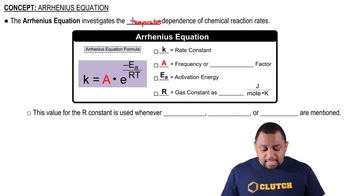
Step 1: Identify the Arrhenius equation, which relates the rate constant k to the temperature T and the activation energy Ea: k = A * e^(-Ea/(RT)), where A is the pre-exponential factor, R is the gas constant (8.314 J/(mol*K)), and T is the temperature in Kelvin.
Step 2: Convert the given temperatures from Celsius to Kelvin by adding 273.15 to each temperature. For example, 20°C becomes 293.15 K and 60°C becomes 333.15 K.
Step 3: Use the Arrhenius equation in its logarithmic form to find the new rate constant k2 at 60°C: ln(k2/k1) = -Ea/R * (1/T2 - 1/T1), where k1 is the initial rate constant at 20°C, T1 is the initial temperature in Kelvin, and T2 is the final temperature in Kelvin.
Step 4: Substitute the given values into the logarithmic form of the Arrhenius equation for part (a) with Ea = 75.5 kJ/mol, converting Ea to J/mol by multiplying by 1000.
Step 5: Repeat Step 4 for part (b) with Ea = 125 kJ/mol, again converting Ea to J/mol by multiplying by 1000. Solve for k2 in each case.

주요 개념

질문에 올바르게 답하기 위해 반드시 이해해야 하는 핵심 개념들은 다음과 같습니다.

First-Order Reactions

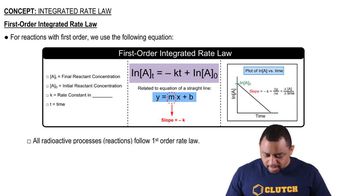
First-order reactions are chemical reactions where the rate is directly proportional to the concentration of one reactant. This means that if the concentration of the reactant doubles, the reaction rate also doubles. The rate law for a first-order reaction can be expressed as rate = k[A], where k is the rate constant and [A] is the concentration of the reactant.
추천 영상:
가이드 코스
02:29
First-Order Reactions

Arrhenius Equation

The Arrhenius equation describes how the rate constant (k) of a reaction depends on temperature (T) and activation energy (Ea). It is given by k = A * e^(-Ea/RT), where A is the pre-exponential factor, R is the universal gas constant, and T is the temperature in Kelvin. This equation allows us to calculate the rate constant at different temperatures if we know the activation energy.
추천 영상:
가이드 코스
01:20
Arrhenius Equation

Activation Energy (Ea)

Activation energy (Ea) is the minimum energy required for a chemical reaction to occur. It represents the energy barrier that reactants must overcome to form products. A higher activation energy means that fewer molecules have sufficient energy to react at a given temperature, resulting in a slower reaction rate. Understanding Ea is crucial for predicting how temperature changes affect reaction rates.
추천 영상:
가이드 코스
02:02
Activity Series Chart