Ch.14 - Chemical Kinetics
Brown - Chemistry: The Central Science 14th Edition
Brown14th EditionChemistry: The Central ScienceISBN: 9780134414232당신이 사용하는 게 아니라요?교과서 변경
14장, 문제 59

Based on their activation energies and energy changes and assuming that all collision factors are the same, rank the following reactions from slowest to fastest. (a) Ea = 45 kJ>mol; E = -25 kJ>mol (b) Ea = 35 kJ>mol; E = -10 kJ>mol (c) Ea = 55 kJ>mol; E = 10 kJ>mol

검증된 단계별 안내
1
Understand the concept of activation energy (Ea) and its role in reaction rates. Activation energy is the minimum energy required for a reaction to occur. The higher the activation energy, the slower the reaction rate, assuming all other factors are constant.
Examine the given activation energies for each reaction. Reaction (a) has an Ea of 45 kJ/mol, reaction (b) has an Ea of 35 kJ/mol, and reaction (c) has an Ea of 55 kJ/mol.
Compare the activation energies to determine the relative speed of the reactions. Lower activation energies generally lead to faster reactions because less energy is required to reach the transition state.
Rank the reactions based on their activation energies from lowest to highest. Reaction (b) has the lowest activation energy, followed by reaction (a), and then reaction (c) has the highest.
Conclude that the reaction with the lowest activation energy (reaction b) is the fastest, followed by reaction (a), and the reaction with the highest activation energy (reaction c) is the slowest.

비슷한 문제에 대한 검증된 영상 답변:

이 영상 해법은 위 문제에 도움이 된다고 튜터들이 추천한 것입니다.
영상 길이:
1m
도움이 되었나요?

주요 개념

질문에 올바르게 답하기 위해 반드시 이해해야 하는 핵심 개념들은 다음과 같습니다.

Activation Energy (Ea)

Activation energy is the minimum energy required for a chemical reaction to occur. It represents the energy barrier that reactants must overcome to form products. A lower activation energy typically correlates with a faster reaction rate, as fewer energy collisions are needed to initiate the reaction.
추천 영상:
가이드 코스
02:02
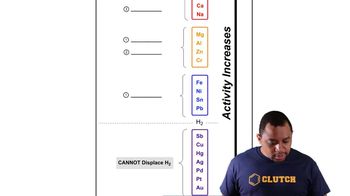
Activity Series Chart

Energy Change (E)

The energy change of a reaction, often denoted as ΔE, indicates the difference in energy between the reactants and products. A negative ΔE signifies an exothermic reaction, where energy is released, while a positive ΔE indicates an endothermic reaction, where energy is absorbed. This energy change can influence the reaction rate, but activation energy is the more critical factor.
추천 영상:
가이드 코스
01:53
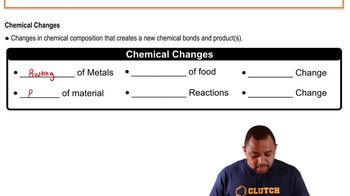
Chemical Changes

Collision Theory

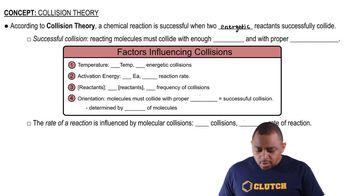
Collision theory states that for a reaction to occur, reactant particles must collide with sufficient energy and proper orientation. While the frequency and energy of collisions are essential, the activation energy determines how many of these collisions will lead to a successful reaction. Thus, understanding collision factors helps in ranking reaction rates based on their activation energies.
추천 영상:
가이드 코스
02:08
Collision Theory