Ch.14 - Chemical Kinetics
Brown - Chemistry: The Central Science 14th Edition
Brown14th EditionChemistry: The Central ScienceISBN: 9780134414232당신이 사용하는 게 아니라요?교과서 변경
14장, 문제 65

What is meant by the term elementary reaction? What is a reaction mechanism? What is meant by the term rate-determining step?

검증된 단계별 안내
1
An elementary reaction is a single step reaction that occurs in a single event or step, where reactants are converted directly into products. It represents a simple collision between molecules that leads to a chemical change.
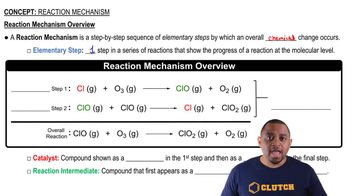
A reaction mechanism is a detailed description of the step-by-step process by which reactants are transformed into products. It includes all the elementary reactions that occur during the overall reaction and provides insight into the sequence of molecular events.
The rate-determining step is the slowest step in a reaction mechanism that determines the overall rate of the reaction. It acts as a bottleneck, limiting the speed at which the entire reaction can proceed.
In a reaction mechanism, each elementary step has its own rate law, and the rate-determining step's rate law is often used to describe the rate law for the overall reaction.
Understanding the rate-determining step is crucial for predicting how changes in conditions (like concentration or temperature) will affect the overall reaction rate.

주요 개념

질문에 올바르게 답하기 위해 반드시 이해해야 하는 핵심 개념들은 다음과 같습니다.

Elementary Reaction

An elementary reaction is a single step process in a chemical reaction where reactants are converted to products in a straightforward manner. These reactions occur in a single molecular event and are characterized by a specific stoichiometry. The rate of an elementary reaction is directly proportional to the concentration of the reactants involved, making it easier to analyze and predict.
추천 영상:
가이드 코스
03:06
Reaction Mechanism Overview

Reaction Mechanism

A reaction mechanism is a detailed description of the step-by-step sequence of elementary reactions that occur during a chemical transformation. It outlines how reactants are converted into products, including the formation of intermediates and the specific pathways taken. Understanding the mechanism helps chemists predict the behavior of reactions under various conditions and can inform the design of new reactions.
추천 영상:
가이드 코스
03:06
Reaction Mechanism Overview

Rate-Determining Step

The rate-determining step is the slowest step in a reaction mechanism that limits the overall rate of the reaction. It acts as a bottleneck, meaning that even if other steps are fast, the rate of the entire reaction cannot exceed that of the slowest step. Identifying the rate-determining step is crucial for understanding how to manipulate reaction conditions to increase the reaction rate.
추천 영상:
가이드 코스
01:15
Rate Law Determination