Ch.14 - Chemical Kinetics
Brown - Chemistry: The Central Science 14th Edition
Brown14th EditionChemistry: The Central ScienceISBN: 9780134414232당신이 사용하는 게 아니라요?교과서 변경
14장, 문제 65b

(b) What is the difference between a unimolecular and a bimolecular elementary reaction?

검증된 단계별 안내
1
Understand that an elementary reaction is a single step reaction with a specific molecularity, which refers to the number of reactant molecules involved in the reaction.
A unimolecular reaction involves a single reactant molecule undergoing a transformation to form products. An example is the decomposition of a single molecule, such as the isomerization of cyclopropane to propene.
A bimolecular reaction involves two reactant molecules colliding and reacting to form products. An example is the reaction between two molecules of hydrogen gas and one molecule of oxygen gas to form water.
Recognize that the molecularity of a reaction is determined by the number of molecules that come together to react in an elementary step, and it is always a whole number.
Note that the rate law for an elementary reaction can be directly written from its molecularity: unimolecular reactions have a first-order rate law, while bimolecular reactions have a second-order rate law.

비슷한 문제에 대한 검증된 영상 답변:

이 영상 해법은 위 문제에 도움이 된다고 튜터들이 추천한 것입니다.
영상 길이:
55s
도움이 되었나요?

주요 개념

질문에 올바르게 답하기 위해 반드시 이해해야 하는 핵심 개념들은 다음과 같습니다.

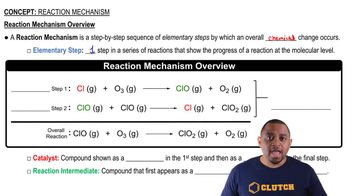
Elementary Reactions

Elementary reactions are the simplest types of chemical reactions that occur in a single step, involving a direct interaction between reactants. They are characterized by their molecularity, which indicates the number of reactant molecules involved in the reaction. Understanding elementary reactions is crucial for analyzing reaction mechanisms and kinetics.
추천 영상:
가이드 코스
03:06
Reaction Mechanism Overview

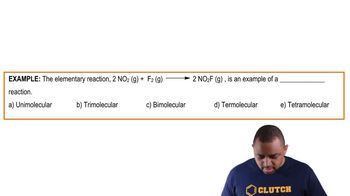
Unimolecular Reactions

Unimolecular reactions involve a single reactant molecule that undergoes a transformation to form products. This type of reaction typically follows first-order kinetics, where the rate of reaction depends solely on the concentration of the single reactant. An example is the isomerization of a molecule, where one molecule rearranges to form another without the involvement of other reactants.
추천 영상:
가이드 코스
01:02
Molecularity in Reactions Example

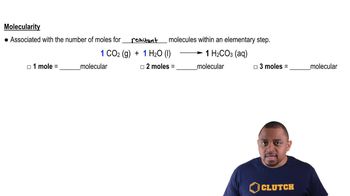
Bimolecular Reactions

Bimolecular reactions involve two reactant molecules that collide and react to form products. These reactions can be either two molecules of the same species or two different species. Bimolecular reactions generally follow second-order kinetics, where the rate of reaction depends on the concentrations of both reactants. An example is the reaction between two different gases to form a product.
추천 영상:
가이드 코스
01:31
Molecularity in Reactions