
(a) The activation energy for the isomerization of methyl isonitrile (Figure 14.6) is 160 kJ>mol. Calculate the fraction of methyl isonitrile molecules that has an energy equal to or greater than the activation energy at 500 K. (b) Calculate this fraction for a temperature of 520 K. What is the ratio of the fraction at 520 K to that at 500 K?
Ch.14 - Chemical Kinetics
14장, 문제 51b
(b) Does the rate constant for a reaction generally increase or decrease with an increase in reaction temperature?
검증된 단계별 안내1
Understand the relationship between temperature and reaction rate: The rate of a chemical reaction typically depends on the temperature at which the reaction is carried out.
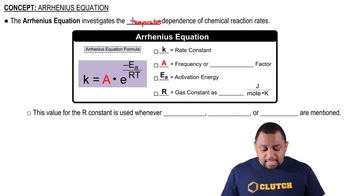
Recall the Arrhenius Equation: This equation, given by \( k = A e^{-\frac{E_a}{RT}} \), where \( k \) is the rate constant, \( A \) is the frequency factor, \( E_a \) is the activation energy, \( R \) is the gas constant, and \( T \) is the temperature in Kelvin, describes how the rate constant changes with temperature.
Analyze the effect of increasing temperature: Increasing the temperature \( T \) in the Arrhenius equation results in a decrease in the value of the exponent \( -\frac{E_a}{RT} \), making the entire exponent larger (less negative).
Examine the exponential term: As the exponent becomes larger, the value of \( e^{-\frac{E_a}{RT}} \) increases because the negative exponent becomes less negative.
Conclude the effect on rate constant: Since the exponential term increases with an increase in temperature, the rate constant \( k \) also increases.

비슷한 문제에 대한 검증된 영상 답변:
이 영상 해법은 위 문제에 도움이 된다고 튜터들이 추천한 것입니다.
영상 길이:
1m도움이 되었나요?
주요 개념
질문에 올바르게 답하기 위해 반드시 이해해야 하는 핵심 개념들은 다음과 같습니다.
Rate Constant
The rate constant (k) is a proportionality factor in the rate equation of a chemical reaction, indicating the speed at which the reaction occurs. It is specific to a particular reaction at a given temperature and is influenced by factors such as temperature, concentration, and the presence of catalysts.
추천 영상:
가이드 코스
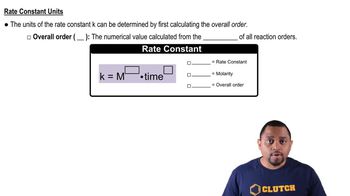
Rate Constant Units
Arrhenius Equation
The Arrhenius equation describes how the rate constant of a reaction changes with temperature. It is expressed as k = A * e^(-Ea/RT), where A is the pre-exponential factor, Ea is the activation energy, R is the gas constant, and T is the temperature in Kelvin. This equation shows that an increase in temperature generally leads to an increase in the rate constant.
추천 영상:
가이드 코스
Arrhenius Equation
Activation Energy
Activation energy (Ea) is the minimum energy required for reactants to undergo a chemical reaction. Higher temperatures provide more kinetic energy to the molecules, increasing the likelihood that they will overcome the activation energy barrier, thus enhancing the reaction rate and increasing the rate constant.
추천 영상:
가이드 코스
Activity Series Chart
관련 실천
교과서 질문
1360
views
교과서 질문
(a) What factors determine whether a collision between two molecules will lead to a chemical reaction?
607
views
교과서 질문
Calculate the fraction of atoms in a sample of argon gas at 400 K that has an energy of 10.0 kJ or greater.
1657
views
1
rank
교과서 질문
Sucrose 1C12H22O112, commonly known as table sugar, reacts in dilute acid solutions to form two simpler sugars, glucose and fructose, both of which have the formula C6H12O6. At 23 C and in 0.5 M HCl, the following data were obtained for the disappearance of sucrose: Time (min) 3C12H22o11 4 1M2 0 0.316 39 0.274 80 0.238 140 0.190 210 0.146 (a) Is the reaction first order or second order with respect to 3C12H22O114?
2567
views
