

Ch.14 - Chemical Kinetics
Brown - Chemistry: The Central Science 14th Edition
Brown14th EditionChemistry: The Central ScienceISBN: 9780134414232당신이 사용하는 게 아니라요?교과서 변경
14장, 문제 51a

(a) What factors determine whether a collision between two molecules will lead to a chemical reaction?

검증된 단계별 안내
1
Identify the kinetic energy of the colliding molecules. The molecules must have sufficient kinetic energy to overcome the activation energy barrier of the reaction.
Consider the orientation of the molecules during collision. The molecules must be oriented in a specific way that allows for the proper alignment of atoms that will bond together.
Examine the molecular structure and the presence of any functional groups that might influence the reaction pathway or the stability of the transition state.
Assess the reaction conditions such as temperature and pressure, as these can affect the kinetic energy of the molecules and the frequency of collisions.
Evaluate the presence of catalysts, which can lower the activation energy and change the required orientation for a successful reaction.

비슷한 문제에 대한 검증된 영상 답변:

이 영상 해법은 위 문제에 도움이 된다고 튜터들이 추천한 것입니다.
영상 길이:
3m
도움이 되었나요?

주요 개념

질문에 올바르게 답하기 위해 반드시 이해해야 하는 핵심 개념들은 다음과 같습니다.

Collision Theory

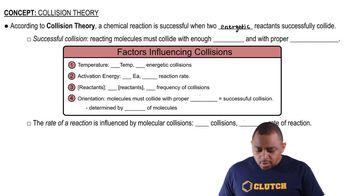
Collision theory posits that for a chemical reaction to occur, reactant molecules must collide with sufficient energy and proper orientation. The energy of the collision must be equal to or greater than the activation energy, which is the minimum energy required to initiate a reaction. Additionally, the orientation of the colliding molecules must allow for the formation of new bonds.
추천 영상:
가이드 코스
02:08
Collision Theory

Activation Energy

Activation energy is the energy barrier that must be overcome for a reaction to proceed. It represents the minimum energy required for reactants to transform into products. Factors such as temperature and the presence of catalysts can influence the activation energy, thereby affecting the rate of the reaction by increasing the number of effective collisions.
추천 영상:
가이드 코스
02:02
Activity Series Chart

Molecular Orientation

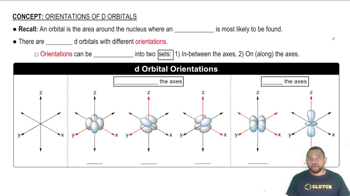
Molecular orientation refers to the specific alignment of molecules during a collision. For a reaction to occur, the molecules must collide in a way that allows for the breaking and forming of bonds. This means that certain orientations are more favorable than others, and understanding these orientations can help predict the likelihood of a reaction occurring during molecular collisions.
추천 영상:
가이드 코스
02:06
d Orbital Orientations