
교과서 질문
A reaction A + B → C obeys the following rate law: Rate = k[B]2. (a) If [A] is doubled, how will the rate change? Will the rate constant change?
1323
views

 검증된 단계별 안내
 01:16
01:16
 02:03
02:03 02:09
02:09A reaction A + B → C obeys the following rate law: Rate = k[B]2. (a) If [A] is doubled, how will the rate change? Will the rate constant change?
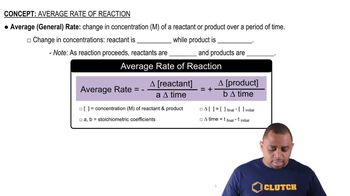
For each of the following gas-phase reactions, write the rate expression in terms of the appearance of each product and disappearance of each reactant:
(a) 2 H2O(g) → 2 H2(g) + O2(g)
(b) 2 SO2(g) + O2(g) → 2 SO3(g)
(c) 2 NO(g) + 2 H2(g) → N2(g) + 2 H2O(g)
(d) N2(g) + 2 H2(g) → N2H4(g)
A reaction A + B → C obeys the following rate law: Rate = k[B]2. (c) What are the units of the rate constant?
(b) The reaction 2 NO1g2 + Cl21g2¡2 NOCl1g2 is carried out in a closed vessel. If the partial pressure of NO is decreasing at the rate of 56 torr/min, what is the rate of change of the total pressure of the vessel?
A reaction A + B → C obeys the following rate law: Rate = k[B]2. (b) What are the reaction orders for A and B? What is the overall reaction order?
(a) Consider the combustion of hydrogen, 2 H21g2 + O21g2 ¡ 2 H2O1g2. If hydrogen is burning at the rate of 0.48 mol>s, what is the rate of consumption of oxygen? What is the rate of formation of water vapor?