Ch.14 - Chemical Kinetics
Brown - Chemistry: The Central Science 14th Edition
Brown14th EditionChemistry: The Central ScienceISBN: 9780134414232당신이 사용하는 게 아니라요?교과서 변경
14장, 문제 28a

Consider a hypothetical reaction between A, B, and C that is first order in A, zero order in B, and second order in C. (a) Write the rate law for the reaction.

검증된 단계별 안내
1
insert step 1> Identify the order of the reaction with respect to each reactant. The problem states that the reaction is first order in A, zero order in B, and second order in C.
insert step 2> Recall that the rate law for a reaction is expressed as: \( \text{Rate} = k[A]^m[B]^n[C]^p \), where \( k \) is the rate constant, and \( m, n, \) and \( p \) are the orders of the reaction with respect to A, B, and C, respectively.
insert step 3> Substitute the given orders into the rate law expression: \( m = 1 \), \( n = 0 \), and \( p = 2 \).
insert step 4> Write the rate law using the substituted values: \( \text{Rate} = k[A]^1[B]^0[C]^2 \).
insert step 5> Simplify the rate law expression by removing any terms raised to the power of zero, as they equal 1: \( \text{Rate} = k[A][C]^2 \).

비슷한 문제에 대한 검증된 영상 답변:

이 영상 해법은 위 문제에 도움이 된다고 튜터들이 추천한 것입니다.
영상 길이:
4m
도움이 되었나요?

주요 개념

질문에 올바르게 답하기 위해 반드시 이해해야 하는 핵심 개념들은 다음과 같습니다.

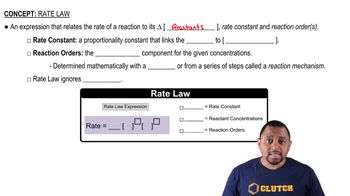
Rate Law

The rate law of a chemical reaction expresses the relationship between the rate of the reaction and the concentration of its reactants. It is typically formulated as an equation where the rate is proportional to the concentrations of the reactants raised to their respective orders. The order of a reactant indicates how the rate is affected by changes in its concentration.
추천 영상:
가이드 코스
01:52
Rate Law Fundamentals

Reaction Order

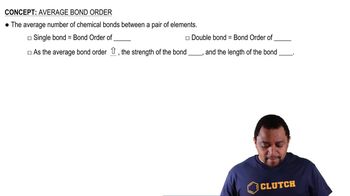
Reaction order refers to the exponent to which the concentration of a reactant is raised in the rate law. It can be determined experimentally and indicates the sensitivity of the reaction rate to changes in that reactant's concentration. In this case, the reaction is first order in A, zero order in B, and second order in C, meaning the rate depends linearly on A, is independent of B, and depends quadratically on C.
추천 영상:
가이드 코스
00:36
Average Bond Order

Units of Rate Constant

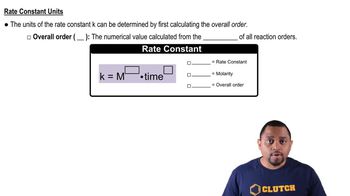
The units of the rate constant (k) in a rate law depend on the overall order of the reaction. For a reaction that is first order in A, zero order in B, and second order in C, the overall order is 3 (1 + 0 + 2). The units of k for this reaction would be M^-2 s^-1, where M is molarity, reflecting how the rate of reaction changes with the concentrations of the reactants.
추천 영상:
가이드 코스
00:45
Rate Constant Units
관련 실천
교과서 질문

A reaction A + B → C obeys the following rate law: Rate = k[B]2. (a) If [A] is doubled, how will the rate change? Will the rate constant change?

1323
views

교과서 질문

A reaction A + B → C obeys the following rate law: Rate = k[B]2. (c) What are the units of the rate constant?

교과서 질문

Consider a hypothetical reaction between A, B, and C that is first order in A, zero order in B, and second order in C. (b) How does the rate change when [A] is doubled and the other reactant concentrations are held constant? (c) How does the rate change when [B] is tripled and the other reactant concentrations are held constant? (d) How does the rate change when [C] is tripled and the other reactant concentrations are held constant? (f) By what factor does the rate change when the concentrations of all three reactants are cut in half?

교과서 질문

The decomposition reaction of N2O5 in carbon tetrachloride is 2 N2O5 → 4 NO2 + O2. The rate law is first order in N2O5. At 64°C the rate constant is 4.82 × 10⁻³ s-1. (a) Write the rate law for the reaction.

3127
views
교과서 질문

A reaction A + B → C obeys the following rate law: Rate = k[B]2. (b) What are the reaction orders for A and B? What is the overall reaction order?

522
views
교과서 질문

Consider a hypothetical reaction between A, B, and C that is first order in A, zero order in B, and second order in C. (e) By what factor does the rate change when the concentrations of all three reactants are tripled?

1050
views