
Ch.14 - Chemical Kinetics
Brown - Chemistry: The Central Science 14th Edition
Brown14th EditionChemistry: The Central ScienceISBN: 9780134414232당신이 사용하는 게 아니라요?교과서 변경
14장, 문제 47c

Consider the data presented in Exercise 14.19. (c) What is the half-life for the reaction?
Table showing time in minutes and corresponding moles of substance C for chemical kinetics.

검증된 단계별 안내
1
Step 1: Identify the initial concentration of substance C at time t=0, which is 0.045 moles.
Step 2: Determine the concentration of substance C at various time intervals from the table provided.
Step 3: Calculate the time it takes for the concentration of substance C to decrease to half of its initial value (0.045/2 = 0.0225 moles).
Step 4: Compare the calculated half concentration with the values in the table to find the corresponding time.
Step 5: The time at which the concentration of substance C is closest to 0.0225 moles is the half-life of the reaction.

비슷한 문제에 대한 검증된 영상 답변:

이 영상 해법은 위 문제에 도움이 된다고 튜터들이 추천한 것입니다.
영상 길이:
7m
도움이 되었나요?

주요 개념

질문에 올바르게 답하기 위해 반드시 이해해야 하는 핵심 개념들은 다음과 같습니다.

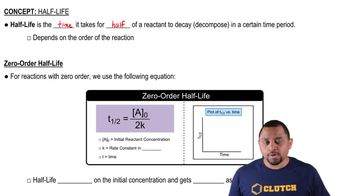
Half-life

Half-life is the time required for the concentration of a reactant to decrease to half of its initial value. In chemical kinetics, it is a crucial concept for understanding the rate of a reaction and is particularly useful for first-order reactions, where the half-life remains constant regardless of the initial concentration.
추천 영상:
가이드 코스
02:17
Zero-Order Half-life

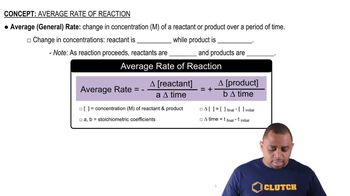
Reaction Rate

The reaction rate is a measure of how quickly reactants are converted into products in a chemical reaction. It can be expressed in terms of the change in concentration of a reactant or product over time. Understanding the reaction rate is essential for calculating half-lives and predicting how long a reaction will take to reach a certain point.
추천 영상:
가이드 코스
02:03
Average Rate of Reaction

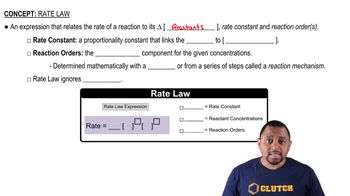
Integrated Rate Laws

Integrated rate laws relate the concentration of reactants or products to time, allowing for the calculation of concentrations at any given time. For first-order reactions, the integrated rate law can be used to determine the half-life and is expressed as ln([A]0/[A]) = kt, where [A]0 is the initial concentration, [A] is the concentration at time t, and k is the rate constant.
추천 영상:
가이드 코스
01:52
Rate Law Fundamentals