
Ch.14 - Chemical Kinetics
Brown - Chemistry: The Central Science 14th Edition
Brown14th EditionChemistry: The Central ScienceISBN: 9780134414232당신이 사용하는 게 아니라요?교과서 변경
14장, 문제 48

Consider the data presented in Exercise 14.20. (a) Determine whether the reaction is first order or second order.

검증된 단계별 안내
1
Step 1: Review the data from Exercise 14.20, which should include concentration and time information for the reaction. This data is crucial for determining the order of the reaction.
Step 2: Plot the concentration of the reactant versus time to visually inspect if the reaction follows a first-order or second-order kinetic model. For a first-order reaction, a plot of ln(concentration) versus time should yield a straight line.
Step 3: Alternatively, plot 1/concentration versus time. For a second-order reaction, this plot should yield a straight line.
Step 4: Calculate the slope of the line from the plot that appears linear. For a first-order reaction, the slope of the ln(concentration) versus time plot is equal to -k, where k is the rate constant. For a second-order reaction, the slope of the 1/concentration versus time plot is equal to k.
Step 5: Compare the linearity of the two plots to determine the order of the reaction. The plot that results in a straight line indicates the order of the reaction: first-order if ln(concentration) versus time is linear, and second-order if 1/concentration versus time is linear.

주요 개념

질문에 올바르게 답하기 위해 반드시 이해해야 하는 핵심 개념들은 다음과 같습니다.

Reaction Order

Reaction order refers to the power to which the concentration of a reactant is raised in the rate law of a chemical reaction. It indicates how the rate of reaction depends on the concentration of reactants. A first-order reaction depends linearly on the concentration of one reactant, while a second-order reaction depends on the square of the concentration of one reactant or the product of the concentrations of two reactants.
추천 영상:
가이드 코스
00:36
Average Bond Order

Rate Law

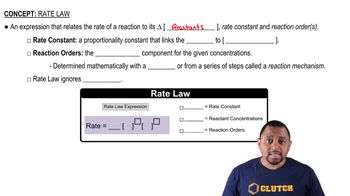
The rate law is an equation that relates the rate of a chemical reaction to the concentration of its reactants. It is typically expressed in the form Rate = k[A]^m[B]^n, where k is the rate constant, and m and n are the orders of the reaction with respect to reactants A and B, respectively. Analyzing the rate law helps determine the reaction order by examining how changes in concentration affect the reaction rate.
추천 영상:
가이드 코스
01:52
Rate Law Fundamentals

Integrated Rate Laws

Integrated rate laws provide a mathematical relationship between the concentration of reactants and time for different orders of reactions. For first-order reactions, the integrated rate law is ln[A] = -kt + ln[A]₀, while for second-order reactions, it is 1/[A] = kt + 1/[A]₀. By plotting concentration data over time and analyzing the resulting graphs, one can determine the order of the reaction based on which plot yields a straight line.
추천 영상:
가이드 코스
01:52
Rate Law Fundamentals