Ch.14 - Chemical Kinetics
Brown - Chemistry: The Central Science 14th Edition
Brown14th EditionChemistry: The Central ScienceISBN: 9780134414232당신이 사용하는 게 아니라요?교과서 변경
14장, 문제 89c

Consider the reaction A + B → C + D. Is each of the following statements true or false? (c) If the reaction is an elementary reaction, the rate law of the reverse reaction is first order.

검증된 단계별 안내
1
insert step 1> Understand that an elementary reaction is a single-step process where the rate law can be directly written from the stoichiometry of the reaction.
insert step 2> For the given reaction A + B → C + D, if it is an elementary reaction, the rate law for the forward reaction is rate = k[A][B], where k is the rate constant.
insert step 3> Consider the reverse reaction C + D → A + B. If this reverse reaction is also elementary, its rate law can be written directly from its stoichiometry.
insert step 4> The rate law for the reverse reaction would be rate = k'[C][D], where k' is the rate constant for the reverse reaction.
insert step 5> Since the rate law for the reverse reaction depends on the concentration of two reactants, C and D, it is second order, not first order. Therefore, the statement is false.

비슷한 문제에 대한 검증된 영상 답변:

이 영상 해법은 위 문제에 도움이 된다고 튜터들이 추천한 것입니다.
영상 길이:
1m

주요 개념

질문에 올바르게 답하기 위해 반드시 이해해야 하는 핵심 개념들은 다음과 같습니다.

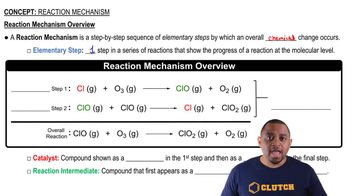
Elementary Reactions

An elementary reaction is a single step process in which reactants are converted to products in a single transition state. The rate law for an elementary reaction can be directly derived from its stoichiometry, meaning the rate is proportional to the concentration of the reactants raised to the power of their coefficients in the balanced equation.
추천 영상:
가이드 코스
03:06
Reaction Mechanism Overview

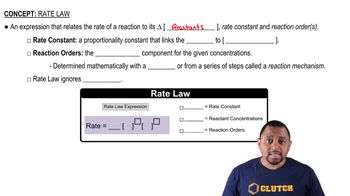
Rate Laws

Rate laws express the relationship between the rate of a chemical reaction and the concentration of its reactants. For elementary reactions, the rate law is straightforward, while for complex reactions, it may involve intermediates and cannot be directly inferred from stoichiometry. The order of the reaction indicates how the rate is affected by the concentration of reactants.
추천 영상:
가이드 코스
01:52
Rate Law Fundamentals

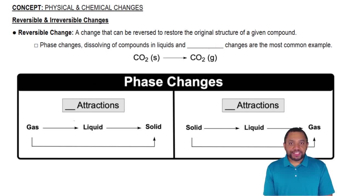
Reverse Reactions

The reverse reaction is the process in which products are converted back into reactants. For an elementary reaction, if the forward reaction is first order with respect to a reactant, the reverse reaction will also exhibit a specific order based on the stoichiometry of the products. Understanding the relationship between forward and reverse reactions is crucial for determining the rate laws of both directions.
추천 영상:
가이드 코스
03:42
Reversible Changes in Matter