The reaction 2 NO(g) + O2(g) → 2 NO2 (g) is second order in NO and first order in O2. When [NO] = 0.040 M, and [O2] = 0.035 M, the observed rate of disappearance of NO is 9.3⨉10-5 M/s. (b) What is the value of the rate constant?
Ch.14 - Chemical Kinetics
14장, 문제 89b
Consider the reaction A + B → C + D. Is each of the following statements true or false? (b) If the reaction is an elementary reaction, the rate law is second order.
검증된 단계별 안내1
Identify the type of reaction given. In this case, it is an elementary reaction involving reactants A and B.
Understand that for elementary reactions, the rate law can be directly written from the stoichiometry of the reaction as it appears in the balanced equation.
Recognize that each reactant in an elementary reaction contributes to the rate law according to its stoichiometric coefficient in the balanced equation.
Since the reaction is A + B → C + D, both A and B have a stoichiometric coefficient of 1.
Write the rate law based on the stoichiometry: Rate = k[A][B]. This indicates that the reaction is second order (first order in A and first order in B).

비슷한 문제에 대한 검증된 영상 답변:
이 영상 해법은 위 문제에 도움이 된다고 튜터들이 추천한 것입니다.
영상 길이:
1m주요 개념
질문에 올바르게 답하기 위해 반드시 이해해야 하는 핵심 개념들은 다음과 같습니다.
Elementary Reactions
An elementary reaction is a single step process in which reactants are converted to products in a single transition state. The rate of an elementary reaction is directly related to the molecularity, which is the number of reactant molecules involved. For example, a reaction involving two reactant molecules is bimolecular and typically has a rate law that reflects this molecularity.
추천 영상:
가이드 코스
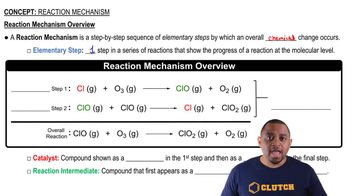
Reaction Mechanism Overview
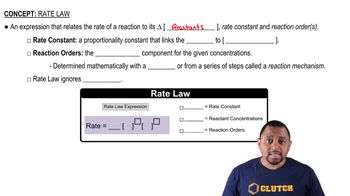
Rate Law
The rate law of a chemical reaction expresses the relationship between the rate of the reaction and the concentration of its reactants. It is determined experimentally and can vary depending on the reaction mechanism. For elementary reactions, the rate law can be directly derived from the stoichiometry of the reaction, meaning that the exponents in the rate law correspond to the coefficients in the balanced equation.
추천 영상:
가이드 코스
Rate Law Fundamentals
Order of Reaction
The order of a reaction is the sum of the powers of the concentration terms in the rate law. It indicates how the rate of reaction is affected by the concentration of reactants. A second-order reaction can arise from either a single elementary reaction involving two reactant molecules or from two first-order reactions, thus the statement in the question can be true if the reaction is indeed second order.
추천 영상:
가이드 코스
Average Bond Order
관련 실천
교과서 질문
403
views
교과서 질문
The reaction 2 NO(g) + O2(g) → 2 NO2 (g) is second order in NO and first order in O2. When [NO] = 0.040 M, and [O2] = 0.035 M, the observed rate of disappearance of NO is 9.3⨉10-5 M/s. (c) What are the units of the rate constant?
735
views
교과서 질문
Consider the reaction A + B → C + D. Is each of the following statements true or false? (c) If the reaction is an elementary reaction, the rate law of the reverse reaction is first order.
776
views
교과서 질문
The activation energy of an uncatalyzed reaction is 95 kJ/mol. The addition of a catalyst lowers the activation energy to 55 kJ/mol. Assuming that the collision factor remains the same, by what factor will the catalyst increase the rate of the reaction at (b) 125 °C?
1218
views