Ch.14 - Chemical Kinetics
Brown - Chemistry: The Central Science 14th Edition
Brown14th EditionChemistry: The Central ScienceISBN: 9780134414232당신이 사용하는 게 아니라요?교과서 변경
14장, 문제 96

Consider two reactions. Reaction (1) has a constant halflife, whereas reaction (2) has a half-life that gets longer as the reaction proceeds. What can you conclude about the rate laws of these reactions from these observations?

검증된 단계별 안내
1
Step 1: Understand the concept of half-life. The half-life of a reaction is the time it takes for the concentration of a reactant to decrease by half. It is a measure of how quickly a reaction proceeds.
Step 2: For reaction (1), the half-life is constant. This means that the time it takes for the reactant to decrease by half is the same no matter how much reactant is left. This is characteristic of a first-order reaction, where the rate of the reaction is directly proportional to the concentration of one reactant.
Step 3: For reaction (2), the half-life gets longer as the reaction proceeds. This means that the time it takes for the reactant to decrease by half increases as the reaction continues. This is characteristic of a zero-order reaction, where the rate of the reaction is independent of the concentration of the reactants.
Step 4: Therefore, from these observations, we can conclude that reaction (1) follows a first-order rate law, while reaction (2) follows a zero-order rate law.
Step 5: Remember that the order of a reaction is determined experimentally and it tells us how the rate of a reaction changes as the concentrations of the reactants change. It is an important concept in chemical kinetics.

비슷한 문제에 대한 검증된 영상 답변:

이 영상 해법은 위 문제에 도움이 된다고 튜터들이 추천한 것입니다.
영상 길이:
4m
도움이 되었나요?

주요 개념

질문에 올바르게 답하기 위해 반드시 이해해야 하는 핵심 개념들은 다음과 같습니다.

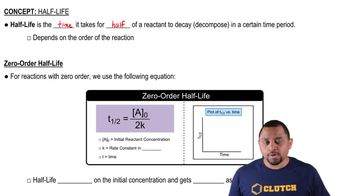
Half-life

Half-life is the time required for the concentration of a reactant to decrease to half of its initial value. In first-order reactions, the half-life is constant and independent of the concentration, while in second-order reactions, the half-life increases as the reaction progresses, indicating a dependence on reactant concentration.
추천 영상:
가이드 코스
02:17
Zero-Order Half-life

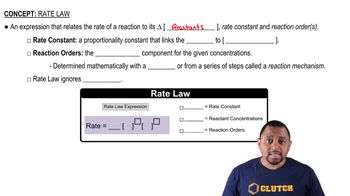
Rate Law

The rate law of a reaction expresses the relationship between the rate of the reaction and the concentration of its reactants. It is determined experimentally and can indicate the order of the reaction, which affects how the rate changes as reactants are consumed. A constant half-life suggests a first-order reaction, while a changing half-life indicates a second-order or higher reaction.
추천 영상:
가이드 코스
01:52
Rate Law Fundamentals

Reaction Order

Reaction order refers to the power to which the concentration of a reactant is raised in the rate law. It provides insight into the mechanism of the reaction. A first-order reaction has a linear relationship between concentration and rate, while a second-order reaction shows a quadratic relationship, leading to a longer half-life as reactants are consumed.
추천 영상:
가이드 코스
00:36
Average Bond Order