

Ch.14 - Chemical Kinetics
Brown - Chemistry: The Central Science 14th Edition
Brown14th EditionChemistry: The Central ScienceISBN: 9780134414232당신이 사용하는 게 아니라요?교과서 변경
14장, 문제 99a,b

Americium-241 is used in smoke detectors. It has a first-order rate constant for radioactive decay of k = 1.6 * 10-3 yr-1. By contrast, iodine-125, which is used to test for thyroid functioning, has a rate constant for radioactive decay of k = 0.011 day-1. (a) What are the half-lives of these two isotopes? (b) Which one decays at a faster rate?

검증된 단계별 안내
1
Step 1: Understand that the rate constant (k) for radioactive decay is a measure of how quickly a radioactive substance decays. The larger the value of k, the faster the substance decays.
Step 2: Compare the given rate constants. Americium-241 has a rate constant of k = 1.6 * 10^-3 yr^-1, while iodine-125 has a rate constant of k = 0.011 day^-1.
Step 3: To compare these values directly, we need to convert them to the same units. There are approximately 365.25 days in a year, so we can convert the rate constant for Americium-241 to day^-1 by multiplying by 365.25.
Step 4: After converting, compare the rate constants again. The substance with the larger rate constant decays faster.
Step 5: Remember that this comparison is based on the rate constants given and does not take into account the amount of each substance present. The actual rate of decay also depends on the amount of the substance present.

비슷한 문제에 대한 검증된 영상 답변:

이 영상 해법은 위 문제에 도움이 된다고 튜터들이 추천한 것입니다.
영상 길이:
6m

주요 개념

질문에 올바르게 답하기 위해 반드시 이해해야 하는 핵심 개념들은 다음과 같습니다.

Radioactive Decay

Radioactive decay is the process by which an unstable atomic nucleus loses energy by emitting radiation. This decay occurs at a characteristic rate for each isotope, defined by its half-life, which is the time required for half of the radioactive atoms in a sample to decay. Understanding this concept is crucial for comparing the decay rates of different isotopes.
추천 영상:
가이드 코스
03:00
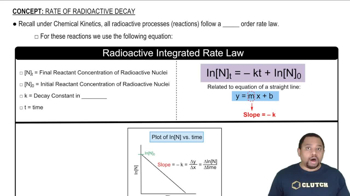
Rate of Radioactive Decay

First-Order Kinetics

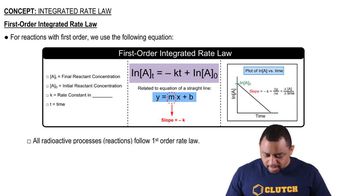
First-order kinetics refers to a reaction rate that is directly proportional to the concentration of one reactant. In the context of radioactive decay, the rate constant (k) indicates how quickly a substance will decay. A higher value of k signifies a faster decay rate, making it essential to compare the rate constants of Americium-241 and Iodine-125 to determine which decays faster.
추천 영상:
가이드 코스
02:29
First-Order Reactions

Unit Conversion

Unit conversion is the process of converting a quantity expressed in one set of units to another. In this question, the decay constants for Americium-241 (in years) and Iodine-125 (in days) must be compared. To accurately assess which isotope decays faster, it is necessary to convert the units of one rate constant to match the other, ensuring a valid comparison.
추천 영상:
가이드 코스
01:56
Conversion Factors