
The reaction between ethyl iodide and hydroxide ion in ethanol (C2H5OH) solution, C2H5I(alc) + OH-(alc) → C2H5OH(l) + I-(alc), has an activation energy of 86.8 kJ/mol and a frequency factor of 2.10 × 10¹¹ M-1 s-1. (c) Which reagent in the reaction is limiting, assuming the reaction proceeds to completion?
Ch.14 - Chemical Kinetics
14장, 문제 116b
Enzymes are often described as following the two-step mechanism:
E + S ⇌ ES (fast)
ES → E + P (slow)
where E = enzyme, S = substrate, ES = enzyme9substrate complex, and P = product.
(b) Molecules that can bind to the active site of an enzyme but are not converted into product are called enzyme inhibitors. Write an additional elementary step to add into the preceding mechanism to account for the reaction of E with I, an inhibitor.
검증된 단계별 안내1
Identify the components involved in the reaction: E (enzyme), S (substrate), ES (enzyme-substrate complex), P (product), and I (inhibitor).
Understand that the inhibitor (I) binds to the enzyme (E) at the active site, preventing the substrate (S) from binding.
Write the elementary step for the binding of the inhibitor to the enzyme: E + I \(\rightleftharpoons\) EI.
Recognize that the formation of the enzyme-inhibitor complex (EI) is a reversible process, similar to the formation of the enzyme-substrate complex (ES).
Note that the presence of the inhibitor affects the overall reaction rate by reducing the availability of the enzyme for the substrate.

비슷한 문제에 대한 검증된 영상 답변:
이 영상 해법은 위 문제에 도움이 된다고 튜터들이 추천한 것입니다.
영상 길이:
1m도움이 되었나요?
주요 개념
질문에 올바르게 답하기 위해 반드시 이해해야 하는 핵심 개념들은 다음과 같습니다.
Enzyme-Substrate Complex Formation
The enzyme-substrate complex (ES) is a transient molecular structure formed when an enzyme (E) binds to its substrate (S). This interaction is crucial for catalysis, as it stabilizes the transition state and lowers the activation energy required for the reaction to proceed. Understanding this step is essential for analyzing how inhibitors can affect enzyme activity.
추천 영상:
가이드 코스
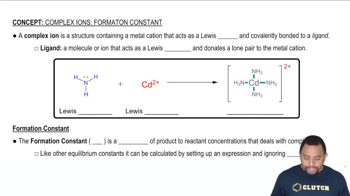
Complex Ions and Formation Constant
Enzyme Inhibition
Enzyme inhibitors are molecules that bind to enzymes and decrease their activity. They can bind to the active site, preventing substrate binding, or to other sites, altering enzyme conformation. Recognizing the role of inhibitors is vital for modifying the reaction mechanism, as they can significantly impact the formation of the enzyme-substrate complex and the overall reaction rate.
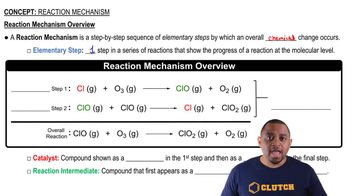
Reaction Mechanism
A reaction mechanism describes the step-by-step sequence of elementary reactions that lead to the formation of products from reactants. In the context of enzyme kinetics, adding an elementary step to account for the interaction between the enzyme and an inhibitor (I) is necessary to fully understand how the inhibitor affects the overall reaction pathway and the dynamics of enzyme activity.
추천 영상:
가이드 코스
Reaction Mechanism Overview
관련 실천
교과서 질문
810
views
교과서 질문
One of the many remarkable enzymes in the human body is carbonic anhydrase, which catalyzes the interconversion of carbon dioxide and water with bicarbonate ion and protons. If it were not for this enzyme, the body could not rid itself rapidly enough of the CO2 accumulated by cell metabolism. The enzyme catalyzes the dehydration (release to air) of up to 107 CO2 molecules per second. Which components of this description correspond to the terms enzyme, substrate, and turnover number?
919
views
교과서 질문
Enzymes are often described as following the two-step mechanism:
E + S ⇌ ES (fast)
ES → E + P (slow)
where E = enzyme, S = substrate, ES = enzyme9substrate complex, and P = product.
(a) If an enzyme follows this mechanism, what rate law is expected for the reaction?
