
Ch.14 - Chemical Kinetics
Brown - Chemistry: The Central Science 14th Edition
Brown14th EditionChemistry: The Central ScienceISBN: 9780134414232당신이 사용하는 게 아니라요?교과서 변경
14장, 문제 118c

The reaction between ethyl iodide and hydroxide ion in ethanol (C2H5OH) solution, C2H5I(alc) + OH-(alc) → C2H5OH(l) + I-(alc), has an activation energy of 86.8 kJ/mol and a frequency factor of 2.10 × 10¹¹ M-1 s-1. (c) Which reagent in the reaction is limiting, assuming the reaction proceeds to completion?

검증된 단계별 안내
1
Step 1: The limiting reagent in a chemical reaction is the reactant that is completely consumed first and determines when the reaction stops. In order to determine the limiting reagent, we need to know the initial amounts of the reactants.
Step 2: However, in this problem, no information is given about the initial amounts of the reactants (ethyl iodide and hydroxide ion). Therefore, we cannot determine which reagent is limiting based on the information provided.
Step 3: If the initial amounts of the reactants were provided, you would compare the number of moles of each reactant. This is done by dividing the initial amount of each reactant by its stoichiometric coefficient in the balanced chemical equation.
Step 4: The reactant that has the smallest value from this calculation is the limiting reagent, as it will be consumed first during the reaction.
Step 5: Remember, the limiting reagent determines the maximum amount of product that can be formed. Once the limiting reagent is used up, the reaction cannot proceed any further.

비슷한 문제에 대한 검증된 영상 답변:

이 영상 해법은 위 문제에 도움이 된다고 튜터들이 추천한 것입니다.
영상 길이:
5m
도움이 되었나요?

주요 개념

질문에 올바르게 답하기 위해 반드시 이해해야 하는 핵심 개념들은 다음과 같습니다.

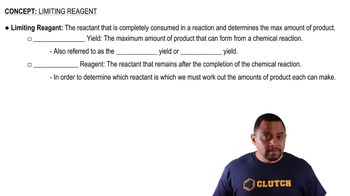
Limiting Reagent

The limiting reagent in a chemical reaction is the reactant that is completely consumed first, thus determining the maximum amount of product that can be formed. To identify the limiting reagent, one must compare the mole ratios of the reactants based on the balanced chemical equation and the initial amounts of each reactant present.
추천 영상:
가이드 코스
01:30
Limiting Reagent Concept

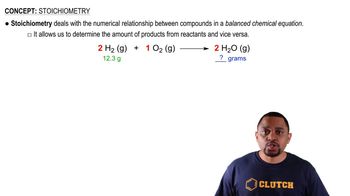
Stoichiometry

Stoichiometry is the calculation of reactants and products in chemical reactions based on the conservation of mass. It involves using the coefficients from a balanced chemical equation to determine the relationships between the quantities of reactants and products, allowing for the prediction of how much of each substance will be consumed or produced.
추천 영상:
가이드 코스
01:16
Stoichiometry Concept

Activation Energy

Activation energy is the minimum energy required for a chemical reaction to occur. It represents the energy barrier that must be overcome for reactants to transform into products. While it does not directly affect which reagent is limiting, understanding activation energy can provide insight into the reaction's rate and feasibility.
추천 영상:
가이드 코스
02:02
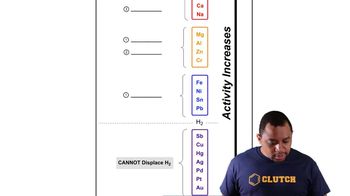
Activity Series Chart
관련 실천
교과서 질문

The reaction between ethyl iodide and hydroxide ion in ethanol (C2H5OH) solution, C2H5I(alc) + OH-(alc) → C2H5OH(l) + I-(alc), has an activation energy of 86.8 kJ/mol and a frequency factor of 2.10 × 10¹¹ M-1 s-1. (d) Assuming the frequency factor and activation energy do not change as a function of temperature, calculate the rate constant for the reaction at 50 C.

532
views
교과서 질문

The gas-phase reaction of NO with F2 to form NOF and F has an activation energy of Ea = 6.3 kJ>mol. and a frequency factor of A = 6.0 * 108 M-1 s-1. The reaction is believed to be bimolecular: NO1g2 + F21g2 ¡ NOF1g2 + F1g2 (e) Suggest a reason for the low activation energy for the reaction.

793
views
교과서 질문

Enzymes are often described as following the two-step mechanism:

E + S  ⇌ ES (fast)

ES → E + P (slow)

where E = enzyme, S = substrate, ES = enzyme9substrate complex, and P = product.

(b) Molecules that can bind to the active site of an enzyme but are not converted into product are called enzyme inhibitors. Write an additional elementary step to add into the preceding mechanism to account for the reaction of E with I, an inhibitor.

1129
views
1
rank
교과서 질문

The gas-phase reaction of NO with F2 to form NOF and F has an activation energy of Ea = 6.3 kJ/mol. and a frequency factor of A = 6.0 × 10⁸ M-1 s-1. The reaction is believed to be bimolecular: NO(g) + F2(g) → NOF(g) + F(g) (b) Draw the Lewis structures for the NO and the NOF molecules, given that the chemical formula for NOF is misleading because the nitrogen atom is actually the central atom in the molecule.