Ch.14 - Chemical Kinetics
Brown - Chemistry: The Central Science 14th Edition
Brown14th EditionChemistry: The Central ScienceISBN: 9780134414232당신이 사용하는 게 아니라요?교과서 변경
14장, 문제 58a

Indicate whether each statement is true or false. (a) If you measure the rate constant for a reaction at different temperatures, you can calculate the overall enthalpy change for the reaction.

검증된 단계별 안내
1
Identify the relationship between the rate constant (k) and temperature, which is described by the Arrhenius equation: \( k = A e^{-\frac{E_a}{RT}} \), where \( A \) is the pre-exponential factor, \( E_a \) is the activation energy, \( R \) is the gas constant, and \( T \) is the temperature in Kelvin.
Understand that the enthalpy change (\( \Delta H \)) of a reaction is different from the activation energy (\( E_a \)). The activation energy is the energy barrier that must be overcome for reactants to transform into products, while the enthalpy change is the overall heat absorbed or released during the reaction.
Recognize that measuring the rate constant at different temperatures primarily provides information about the activation energy through the Arrhenius plot, where plotting \( ln(k) \) versus \( \frac{1}{T} \) gives a slope of \( -\frac{E_a}{R} \).
Conclude that while the activation energy can be derived from the temperature dependence of the rate constant, the overall enthalpy change of the reaction cannot be directly calculated from this data alone, as it requires additional thermodynamic information such as the heat capacities of reactants and products.
Determine the statement as false, since the rate constant measurements at different temperatures allow calculation of the activation energy, not the direct calculation of the overall enthalpy change of the reaction.

비슷한 문제에 대한 검증된 영상 답변:

이 영상 해법은 위 문제에 도움이 된다고 튜터들이 추천한 것입니다.
영상 길이:
1m
도움이 되었나요?

주요 개념

질문에 올바르게 답하기 위해 반드시 이해해야 하는 핵심 개념들은 다음과 같습니다.

Rate Constant and Temperature

The rate constant (k) of a chemical reaction is temperature-dependent, typically increasing with temperature due to higher kinetic energy of molecules. This relationship is described by the Arrhenius equation, which shows how k varies with temperature and activation energy. Understanding this concept is crucial for analyzing how temperature influences reaction rates.
추천 영상:
가이드 코스
00:45
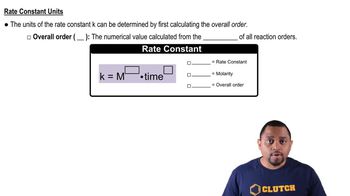
Rate Constant Units

Enthalpy Change (ΔH)

Enthalpy change (ΔH) is a measure of the heat absorbed or released during a chemical reaction at constant pressure. It reflects the difference in energy between reactants and products. While the rate constant can provide insights into reaction kinetics, ΔH is determined through thermodynamic principles, often requiring calorimetric data or Hess's law for accurate calculation.
추천 영상:
가이드 코스
02:34
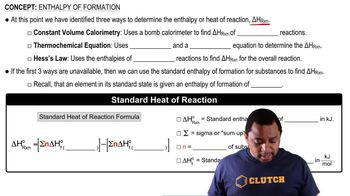
Enthalpy of Formation

Van 't Hoff Equation

The Van 't Hoff equation relates the change in the equilibrium constant of a reaction to the change in temperature and the enthalpy change of the reaction. It allows for the calculation of ΔH if the equilibrium constants at two different temperatures are known. This equation is essential for linking thermodynamics and kinetics, particularly in the context of temperature effects on reaction rates.
추천 영상:
가이드 코스
01:40
Van der Waals Equation