
Ch.14 - Chemical Kinetics
Brown - Chemistry: The Central Science 14th Edition
Brown14th EditionChemistry: The Central ScienceISBN: 9780134414232당신이 사용하는 게 아니라요?교과서 변경
14장, 문제 123

Many primary amines, RNH2, where R is a carbon-containing fragment such as CH3, CH3CH2, and so on, undergo reactions where the transition state is tetrahedral. (b) What kind of reactant with a primary amine can produce a tetrahedral intermediate?

검증된 단계별 안내
1
Understand the concept of a tetrahedral intermediate: In organic chemistry, a tetrahedral intermediate is a transient structure formed during certain reactions, characterized by a central atom bonded to four other atoms or groups, creating a tetrahedral geometry.
Identify the type of reaction that involves a tetrahedral intermediate: A common reaction involving primary amines that leads to a tetrahedral intermediate is nucleophilic addition. This typically occurs when a nucleophile, such as a primary amine, attacks a carbonyl group.
Recognize the structure of a carbonyl group: A carbonyl group consists of a carbon atom double-bonded to an oxygen atom (C=O). This group is highly reactive due to the polarity of the C=O bond, making it susceptible to nucleophilic attack.
Determine the reactant that can form a tetrahedral intermediate with a primary amine: The primary amine can react with a carbonyl compound, such as an aldehyde or ketone, to form a tetrahedral intermediate. The nucleophilic nitrogen atom of the amine attacks the electrophilic carbon atom of the carbonyl group.
Visualize the formation of the tetrahedral intermediate: When the primary amine attacks the carbonyl carbon, the double bond between carbon and oxygen is temporarily broken, and the carbon atom forms new single bonds with the nitrogen atom of the amine and the oxygen atom, resulting in a tetrahedral geometry.

주요 개념

질문에 올바르게 답하기 위해 반드시 이해해야 하는 핵심 개념들은 다음과 같습니다.

Primary Amines

Primary amines are organic compounds characterized by the presence of one amino group (-NH2) attached to a carbon atom. The carbon atom can be part of a larger hydrocarbon chain or ring, represented as 'R' in the general formula RNH2. These compounds are known for their nucleophilic properties, allowing them to react with electrophiles in various chemical reactions.
추천 영상:
가이드 코스
00:28
Rules for Naming Amines

Tetrahedral Intermediate

A tetrahedral intermediate is a transient species that forms during certain chemical reactions, particularly those involving nucleophilic substitution or addition. In this structure, a central atom, typically carbon, is bonded to four substituents, resulting in a tetrahedral geometry. This intermediate is crucial in understanding the mechanism of reactions involving primary amines, as it indicates a change in hybridization and bonding during the reaction process.
추천 영상:
가이드 코스
01:38
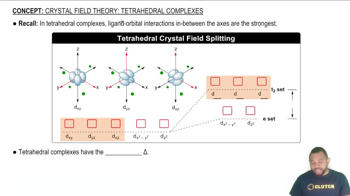
The crystal field splitting pattern for tetrahedral complexes has the d orbitals in between the axes as having the higher energy.

Nucleophilic Substitution Reactions

Nucleophilic substitution reactions involve the replacement of a leaving group in a molecule by a nucleophile, which is a species that donates an electron pair. In the context of primary amines, these reactions often lead to the formation of tetrahedral intermediates when the amine acts as a nucleophile, attacking an electrophilic carbon atom. Understanding this mechanism is essential for predicting the products and pathways of reactions involving primary amines.
추천 영상:
가이드 코스
01:08
Alcohol Reactions: Substitution Reactions
관련 실천