
Ch.14 - Chemical Kinetics
Brown - Chemistry: The Central Science 14th Edition
Brown14th EditionChemistry: The Central ScienceISBN: 9780134414232당신이 사용하는 게 아니라요?교과서 변경
14장, 문제 115

Suppose that, in the absence of a catalyst, a certain biochemical reaction occurs x times per second at normal body temperature 37 °C. In order to be physiologically useful, the reaction needs to occur 5000 times faster than when it is uncatalyzed. By how many kJ/mol must an enzyme lower the activation energy of the reaction to make it useful?

검증된 단계별 안내
1
Step 1: Understand the Arrhenius equation, which relates the rate constant of a reaction to the activation energy and temperature: k = A * e^(-Ea/(RT)), where k is the rate constant, A is the pre-exponential factor, Ea is the activation energy, R is the gas constant (8.314 J/(mol·K)), and T is the temperature in Kelvin.
Step 2: Convert the given temperature from Celsius to Kelvin by adding 273.15 to the Celsius temperature: T(K) = 37 + 273.15.
Step 3: Recognize that the reaction rate needs to be 5000 times faster with the enzyme, which implies that the catalyzed rate constant (k_cat) is 5000 times the uncatalyzed rate constant (k_uncat). Therefore, k_cat = 5000 * k_uncat.
Step 4: Use the Arrhenius equation for both the uncatalyzed and catalyzed reactions: k_uncat = A * e^(-Ea_uncat/(RT)) and k_cat = A * e^(-Ea_cat/(RT)). Set up the equation k_cat/k_uncat = 5000 = e^((Ea_uncat - Ea_cat)/(RT)).
Step 5: Solve for the difference in activation energy (Ea_uncat - Ea_cat) by taking the natural logarithm of both sides: ln(5000) = (Ea_uncat - Ea_cat)/(RT). Rearrange to find Ea_uncat - Ea_cat = R * T * ln(5000).

주요 개념

질문에 올바르게 답하기 위해 반드시 이해해야 하는 핵심 개념들은 다음과 같습니다.

Activation Energy

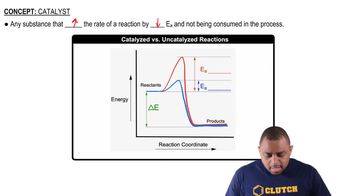
Activation energy is the minimum energy required for a chemical reaction to occur. It represents the energy barrier that reactants must overcome to transform into products. Lowering the activation energy increases the rate of the reaction, making it more likely to occur at a given temperature. In biochemical reactions, enzymes often lower this energy barrier, facilitating faster reactions.
추천 영상:
가이드 코스
02:02
Activity Series Chart

Enzyme Catalysis

Enzymes are biological catalysts that speed up chemical reactions by lowering the activation energy. They achieve this by providing an alternative reaction pathway and stabilizing the transition state. The efficiency of an enzyme is often quantified by its turnover number, which indicates how many substrate molecules one enzyme can convert to product per second. Understanding enzyme kinetics is crucial for determining how much the activation energy must be reduced.
추천 영상:
가이드 코스
01:59
Catalyzed vs. Uncatalyzed Reactions

Arrhenius Equation

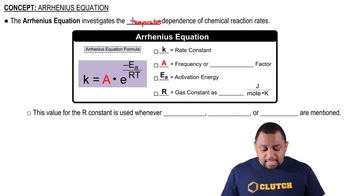
The Arrhenius equation describes the temperature dependence of reaction rates and relates the rate constant of a reaction to the activation energy. It is expressed as k = A * e^(-Ea/RT), where k is the rate constant, A is the pre-exponential factor, Ea is the activation energy, R is the gas constant, and T is the temperature in Kelvin. This equation helps in calculating how changes in activation energy affect reaction rates, which is essential for determining the required reduction in activation energy for the reaction to occur at the desired rate.
추천 영상:
가이드 코스
01:20
Arrhenius Equation
관련 실천
교과서 질문

One of the many remarkable enzymes in the human body is carbonic anhydrase, which catalyzes the interconversion of carbon dioxide and water with bicarbonate ion and protons. If it were not for this enzyme, the body could not rid itself rapidly enough of the CO2 accumulated by cell metabolism. The enzyme catalyzes the dehydration (release to air) of up to 107 CO2 molecules per second. Which components of this description correspond to the terms enzyme, substrate, and turnover number?

919
views
교과서 질문

Platinum nanoparticles of diameter 2 nm are important catalysts in carbon monoxide oxidation to carbon dioxide. Platinum crystallizes in a face-centered cubic arrangement with an edge length of 3.924 Å. (c) Using your results from (a) and (b), calculate the percentage of Pt atoms that are on the surface of a 2.0-nm nanoparticle. (d) Repeat these calculations for a 5.0-nm platinum nanoparticle.

442
views
교과서 질문

Platinum nanoparticles of diameter 2 nm are important catalysts in carbon monoxide oxidation to carbon dioxide. Platinum crystallizes in a face-centered cubic arrangement with an edge length of 3.924 Å. (b) Estimate how many platinum atoms are on the surface of a 2.0-nm Pt sphere, using the surface area of a sphere (4πr2) and assuming that the 'footprint' of one Pt atom can be estimated from its atomic diameter of 2.8 A .

462
views
교과서 질문

Enzymes are often described as following the two-step mechanism:

E + S ⇌ ES (fast)

ES → E + P (slow)

where E = enzyme, S = substrate, ES = enzyme9substrate complex, and P = product.

(a) If an enzyme follows this mechanism, what rate law is expected for the reaction?

교과서 질문

Enzymes are often described as following the two-step mechanism:

E + S  ⇌ ES (fast)

ES → E + P (slow)

where E = enzyme, S = substrate, ES = enzyme9substrate complex, and P = product.

(b) Molecules that can bind to the active site of an enzyme but are not converted into product are called enzyme inhibitors. Write an additional elementary step to add into the preceding mechanism to account for the reaction of E with I, an inhibitor.

1129
views
1
rank