
Ch.14 - Chemical Kinetics
Brown - Chemistry: The Central Science 14th Edition
Brown14th EditionChemistry: The Central ScienceISBN: 9780134414232당신이 사용하는 게 아니라요?교과서 변경
14장, 문제 101

The rate of a first-order reaction is followed by spectroscopy, monitoring the absorbance of a colored reactant at 520 nm. The reaction occurs in a 1.00-cm sample cell, and the only colored species in the reaction has an extinction coefficient of 5.60 * 10^3 M^-1 cm^-1 at 520 nm. If the absorbance falls to 0.250 at 30.0 min, calculate the rate constant in units of s^-1.

검증된 단계별 안내
1
Start by using Beer's Law to relate absorbance (A) to concentration (C) of the colored species. Beer's Law is given by: A=εCl, where ε is the extinction coefficient, C is the concentration, and l is the path length of the sample cell.
Given that the absorbance (A) is 0.250, the extinction coefficient (ε) is 5.60×10³ M-1 cm-1, and the path length (l) is 1.00 cm, solve for the concentration (C) using the equation: C=Aεl.
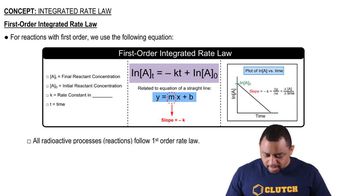
For a first-order reaction, the rate constant (k) can be determined using the integrated rate law: A=Ao×e-kt, where A is the absorbance at time t, Ao is the initial absorbance, and k is the rate constant.
Rearrange the integrated rate law to solve for the rate constant (k): k=-ln(AAo)t. Substitute the values for A, Ao, and t (converted to seconds) into the equation.
Calculate the rate constant (k) using the rearranged equation. Ensure that the time is converted from minutes to seconds by multiplying by 60, as the rate constant is required in units of s-1.

주요 개념

질문에 올바르게 답하기 위해 반드시 이해해야 하는 핵심 개념들은 다음과 같습니다.

First-Order Reactions

First-order reactions are chemical reactions where the rate is directly proportional to the concentration of one reactant. This means that as the concentration of the reactant decreases, the rate of the reaction also decreases. The rate law for a first-order reaction can be expressed as rate = k[A], where k is the rate constant and [A] is the concentration of the reactant.
추천 영상:
가이드 코스
02:29
First-Order Reactions

Beer-Lambert Law

The Beer-Lambert Law relates the absorbance of light to the properties of the material through which the light is traveling. It states that absorbance (A) is equal to the product of the extinction coefficient (ε), the concentration (c) of the absorbing species, and the path length (l) of the sample: A = εcl. This law is crucial for quantifying the concentration of colored species in solution using spectroscopy.
추천 영상:

Rate Constant (k)

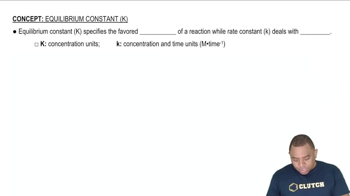
The rate constant (k) is a proportionality factor in the rate law that provides insight into the speed of a reaction. For first-order reactions, the rate constant has units of s^-1, indicating the reaction's dependence on time. The value of k can be determined from experimental data, such as changes in absorbance over time, allowing for the calculation of reaction kinetics.
추천 영상:
가이드 코스
01:14
Equilibrium Constant K
관련 실천
교과서 질문

The rate of a first-order reaction is followed by spectroscopy, monitoring the absorbance of a colored reactant at 520 nm. The reaction occurs in a 1.00-cm sample cell, and the only colored species in the reaction has an extinction coefficient of 5.60 × 10³ M-1 cm-1 at 520 nm.

(d) How long does it take for the absorbance to fall to 0.100?

1061
views
교과서 질문

Americium-241 is used in smoke detectors. It has a first-order rate constant for radioactive decay of k = 1.6 * 10-3 yr-1. By contrast, iodine-125, which is used to test for thyroid functioning, has a rate constant for radioactive decay of k = 0.011 day-1. (a) What are the half-lives of these two isotopes? (b) Which one decays at a faster rate?

1041
views
교과서 질문

The rate of a first-order reaction is followed by spectroscopy, monitoring the absorbance of a colored reactant at 520 nm. The reaction occurs in a 1.00-cm sample cell, and the only colored species in the reaction has an extinction coefficient of 5.60 × 10³ M-1 cm-1 at 520 nm.

(a) Calculate the initial concentration of the colored reactant if the absorbance is 0.605 at the beginning of the reaction.

304
views
교과서 질문

Americium-241 is used in smoke detectors. It has a first-order rate constant for radioactive decay of k = 1.6 * 10-3 yr-1. By contrast, iodine-125, which is used to test for thyroid functioning, has a rate constant for radioactive decay of k = 0.011 day-1. (c) How much of a 1.00-mg sample of each isotope remains after three half-lives? (d) How much of a 1.00-mg sample of each isotope remains after 4 days?

1043
views
교과서 질문

The rate of a first-order reaction is followed by spectroscopy, monitoring the absorbance of a colored reactant at 520 nm. The reaction occurs in a 1.00-cm sample cell, and the only colored species in the reaction has an extinction coefficient of 5.60 × 10³ M-1 cm-1 at 520 nm.

(c) Calculate the half-life of the reaction.

370
views