Ch.15 - Chemical Equilibrium
Brown - Chemistry: The Central Science 14th Edition
Brown14th EditionChemistry: The Central ScienceISBN: 9780134414232당신이 사용하는 게 아니라요?교과서 변경
15장, 문제 41a

(a) If Qc < Kc, in which direction will a reaction proceed in order to reach equilibrium?

검증된 단계별 안내
1
Identify the given terms: Q_c is the reaction quotient, and K_c is the equilibrium constant.
Understand the relationship: If Q_c < K_c, it means the concentration of products is less than what is required at equilibrium.
Determine the direction: The reaction will proceed in the forward direction to produce more products and reach equilibrium.
Visualize the process: As the reaction moves forward, the concentration of reactants will decrease, and the concentration of products will increase.
Conclude the reasoning: The reaction continues in the forward direction until Q_c equals K_c, achieving equilibrium.

비슷한 문제에 대한 검증된 영상 답변:

이 영상 해법은 위 문제에 도움이 된다고 튜터들이 추천한 것입니다.
영상 길이:
1m

주요 개념

질문에 올바르게 답하기 위해 반드시 이해해야 하는 핵심 개념들은 다음과 같습니다.

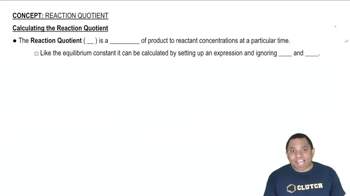
Reaction Quotient (Q<sub>c</sub>)

The reaction quotient, Q<sub>c</sub>, is a measure of the relative concentrations of products and reactants at any point in a reaction. It is calculated using the same expression as the equilibrium constant (K<sub>c</sub>), but with the current concentrations instead of equilibrium concentrations. Q<sub>c</sub> helps determine the direction in which a reaction will shift to reach equilibrium.
추천 영상:
가이드 코스
00:49
Reaction Quotient Q

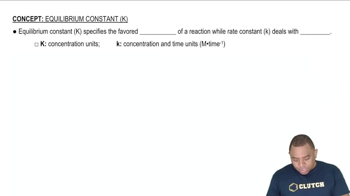
Equilibrium Constant (K<sub>c</sub>)

The equilibrium constant, K<sub>c</sub>, is a value that expresses the ratio of the concentrations of products to reactants at equilibrium for a given reaction at a specific temperature. It is a fixed value for a particular reaction under specified conditions. Comparing Q<sub>c</sub> to K<sub>c</sub> allows us to predict the direction of the reaction's shift towards equilibrium.
추천 영상:
가이드 코스
01:14
Equilibrium Constant K

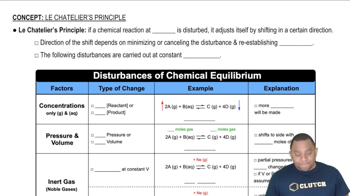
Le Chatelier's Principle

Le Chatelier's Principle states that if a system at equilibrium is disturbed by a change in concentration, temperature, or pressure, the system will adjust to counteract the disturbance and restore a new equilibrium. In the context of Q<sub>c</sub> and K<sub>c</sub>, if Q<sub>c</sub> is less than K<sub>c</sub>, the reaction will shift to the right, favoring the formation of products to achieve equilibrium.
추천 영상:
가이드 코스
07:32
Le Chatelier's Principle