(a) If Qc < Kc, in which direction will a reaction proceed in order to reach equilibrium?
Ch.15 - Chemical Equilibrium
15장, 문제 41b
(b) What condition must be satisfied so that Qc = Kc?
검증된 단계별 안내1
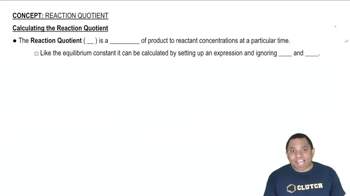
The reaction quotient, , is calculated using the concentrations of the reactants and products at any point in time, not necessarily at equilibrium.
The equilibrium constant, , is calculated using the concentrations of the reactants and products at equilibrium.
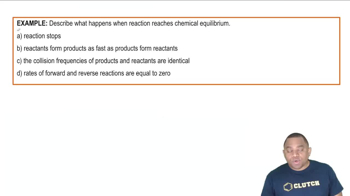
For to equal , the system must be at equilibrium, meaning the concentrations of reactants and products have reached a state where they no longer change with time.
Therefore, the condition that must be satisfied for = is that the reaction mixture is at equilibrium.

비슷한 문제에 대한 검증된 영상 답변:
이 영상 해법은 위 문제에 도움이 된다고 튜터들이 추천한 것입니다.
영상 길이:
53s도움이 되었나요?
주요 개념
질문에 올바르게 답하기 위해 반드시 이해해야 하는 핵심 개념들은 다음과 같습니다.
Reaction Quotient (Q<sub>c</sub>)
The reaction quotient, Q<sub>c</sub>, is a measure of the relative concentrations of products and reactants at any point in a chemical reaction. It is calculated using the same expression as the equilibrium constant but with the current concentrations. Q<sub>c</sub> helps determine the direction in which a reaction will proceed to reach equilibrium.
추천 영상:
가이드 코스
Reaction Quotient Q
Equilibrium Constant (K<sub>c</sub>)
The equilibrium constant, K<sub>c</sub>, is a value that expresses the ratio of the concentrations of products to reactants at equilibrium for a reversible reaction at a given temperature. It is a fixed value for a specific reaction under specific conditions, indicating the extent to which reactants are converted into products at equilibrium.
추천 영상:
가이드 코스
Equilibrium Constant K
Dynamic Equilibrium
Dynamic equilibrium occurs in a reversible reaction when the rates of the forward and reverse reactions are equal, resulting in constant concentrations of reactants and products. At this point, Q<sub>c</sub> equals K<sub>c</sub>, indicating that the system is balanced and no net change occurs. This condition is essential for understanding when a reaction has reached equilibrium.
추천 영상:
가이드 코스
Chemical Equilibrium Example
관련 실천
교과서 질문
546
views
교과서 질문
(a) If Qc > Kc, how must the reaction proceed to reach equilibrium?
874
views
교과서 질문
At 100°C, the equilibrium constant for the reaction COCl2(𝑔) ⇌ CO(𝑔) + Cl2(𝑔) has the value 𝐾𝑐 = 2.19×10⁻¹⁰. Are the following mixtures of COCl2, CO, and Cl2 at 100°C at equilibrium? If not, indicate the direction that the reaction must proceed to achieve equilibrium.
(a) [COCl2] = 2.00×10⁻³ M, [CO] = 3.3×10⁻⁶ M, [Cl2] = 6.62×10⁻⁶ M
(b) [COCl2] = 4.50×10⁻² M, [CO] = 1.1×10⁻⁷ M, [Cl2] = 2.25×10⁻⁶ M
(c) [COCl2] = 0.0100 M, [CO] = [Cl2] = 1.48×10⁻⁶ M
736
views
교과서 질문
(b) At the start of a certain reaction, only reactants are present; no products have been formed. What is the value of Qc at this point in the reaction?
596
views