Ch.15 - Chemical Equilibrium
15์žฅ, ๋ฌธ์ œ 43

At 100ยฐC, the equilibrium constant for the reaction COCl2(๐‘”) โ‡Œ CO(๐‘”) + Cl2(๐‘”) has the value ๐พ๐‘ = 2.19ร—10โˆ’10. Are the following mixtures of COCl2, CO, and Cl2 at 100ยฐC at equilibrium? If not, indicate the direction that the reaction must proceed to achieve equilibrium.
(a) [COCl2] = 2.00ร—10โˆ’3 M, [CO] = 3.3ร—10โˆ’6 M, [Cl2] = 6.62ร—10โˆ’6 M
(b) [COCl2] = 4.50ร—10โˆ’2 M, [CO] = 1.1ร—10โˆ’7 M, [Cl2] = 2.25ร—10โˆ’6 M
(c) [COCl2] = 0.0100 M, [CO] = [Cl2] = 1.48ร—10โˆ’6 M

๊ฒ€์ฆ๋œ ๋‹จ๊ณ„๋ณ„ ์•ˆ๋‚ด
1
Calculate the reaction quotient, Qc, using the formula Qc = \(\frac{[CO][Cl_2]}{[COCl_2]}\).
Substitute the given concentrations into the expression: Qc = \(\frac{(3.3 \times 10^{-6}\) \(\text{ M}\))(6.62 \(\times\) 10^{-6} \(\text{ M}\))}{2.00 \(\times\) 10^{-3} \(\text{ M}\)}.
Compare the calculated Qc with the given equilibrium constant Kc = 2.19 \(\times\) 10^{-10}.
If Qc < Kc, the reaction will proceed in the forward direction to reach equilibrium. If Qc > Kc, the reaction will proceed in the reverse direction.
If Qc = Kc, the system is already at equilibrium.

๋น„์Šทํ•œ ๋ฌธ์ œ์— ๋Œ€ํ•œ ๊ฒ€์ฆ๋œ ์˜์ƒ ๋‹ต๋ณ€:

์ด ์˜์ƒ ํ•ด๋ฒ•์€ ์œ„ ๋ฌธ์ œ์— ๋„์›€์ด ๋œ๋‹ค๊ณ  ํŠœํ„ฐ๋“ค์ด ์ถ”์ฒœํ•œ ๊ฒƒ์ž…๋‹ˆ๋‹ค.
์˜์ƒ ๊ธธ์ด:
5m

์ฃผ์š” ๊ฐœ๋…

์งˆ๋ฌธ์— ์˜ฌ๋ฐ”๋ฅด๊ฒŒ ๋‹ตํ•˜๊ธฐ ์œ„ํ•ด ๋ฐ˜๋“œ์‹œ ์ดํ•ดํ•ด์•ผ ํ•˜๋Š” ํ•ต์‹ฌ ๊ฐœ๋…๋“ค์€ ๋‹ค์Œ๊ณผ ๊ฐ™์Šต๋‹ˆ๋‹ค.

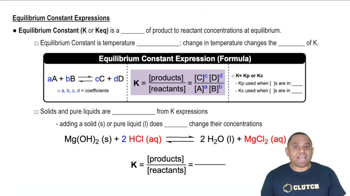
Equilibrium Constant (Kc)

The equilibrium constant (Kc) is a numerical value that expresses the ratio of the concentrations of products to reactants at equilibrium for a given reaction at a specific temperature. For the reaction COClโ‚‚(g) โ‡Œ CO(g) + Clโ‚‚(g), Kc = [CO][Clโ‚‚] / [COClโ‚‚]. A small Kc value, such as 2.19ร—10โปยนโฐ, indicates that at equilibrium, the concentration of reactants is much greater than that of products, suggesting the reaction favors the reactants.
์ถ”์ฒœ ์˜์ƒ:
๊ฐ€์ด๋“œ ์ฝ”์Šค
03:20
Equilibrium Constant Expressions

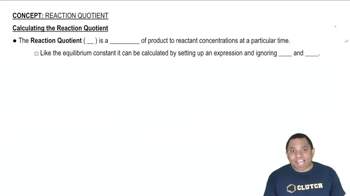
Reaction Quotient (Q)

The reaction quotient (Q) is calculated using the same formula as Kc but with the current concentrations of the reactants and products, regardless of whether the system is at equilibrium. By comparing Q to Kc, one can determine the direction in which the reaction will proceed to reach equilibrium. If Q < Kc, the reaction shifts to the right (toward products); if Q > Kc, it shifts to the left (toward reactants).
์ถ”์ฒœ ์˜์ƒ:

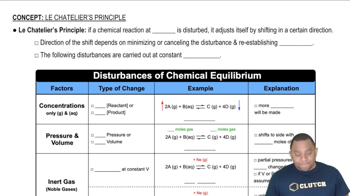
Le Chatelier's Principle

Le Chatelier's Principle states that if a dynamic equilibrium is disturbed by changing the conditions, the system will adjust itself to counteract the change and restore a new equilibrium. This principle helps predict how changes in concentration, pressure, or temperature will affect the position of equilibrium in a chemical reaction, guiding the understanding of how the reaction will shift in response to the concentrations of COClโ‚‚, CO, and Clโ‚‚.
์ถ”์ฒœ ์˜์ƒ: