
Ch.15 - Chemical Equilibrium
Brown - Chemistry: The Central Science 14th Edition
Brown14th EditionChemistry: The Central ScienceISBN: 9780134414232당신이 사용하는 게 아니라요?교과서 변경
15장, 문제 45

At 100 _x001F_C, Kc = 0.078 for the reaction SO2Cl2(g) ⇌ SO2(g) + Cl2(g). In an equilibrium mixture of the three gases, the concentrations of SO2Cl2 and SO2 are 0.108 M and 0.052 M, respectively. What is the partial pressure of Cl2 in the equilibrium mixture?

검증된 단계별 안내
1
Identify the equilibrium expression for the reaction: SO2Cl2(g) ⇌ SO2(g) + Cl2(g). The equilibrium constant expression (Kc) is given by Kc = [SO2][Cl2]/[SO2Cl2].
Substitute the known values into the equilibrium expression. You have [SO2Cl2] = 0.108 M and [SO2] = 0.052 M. The equilibrium constant Kc is 0.078.
Rearrange the equilibrium expression to solve for the unknown concentration of Cl2. This gives [Cl2] = Kc * [SO2Cl2] / [SO2].
Substitute the known values into the rearranged equation to find the concentration of Cl2. This involves multiplying Kc by [SO2Cl2] and then dividing by [SO2].
The concentration of Cl2 obtained from the calculation is the same as its partial pressure in the equilibrium mixture, assuming ideal gas behavior.

주요 개념

질문에 올바르게 답하기 위해 반드시 이해해야 하는 핵심 개념들은 다음과 같습니다.

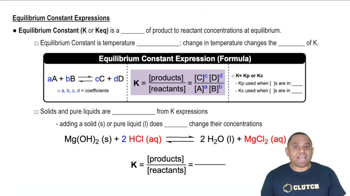
Equilibrium Constant (Kc)

The equilibrium constant (Kc) is a numerical value that expresses the ratio of the concentrations of products to reactants at equilibrium for a given reaction at a specific temperature. For the reaction SO2Cl2(g) ⇌ SO2(g) + Cl2(g), Kc = [SO2][Cl2]/[SO2Cl2]. A Kc value less than 1 indicates that at equilibrium, the concentration of reactants is greater than that of products.
추천 영상:
가이드 코스
03:20
Equilibrium Constant Expressions

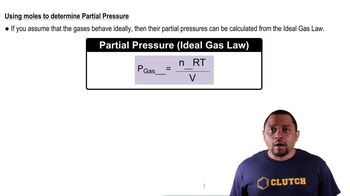
Partial Pressure

Partial pressure is the pressure exerted by a single component of a gas mixture. According to Dalton's Law, the total pressure of a gas mixture is the sum of the partial pressures of each individual gas. The partial pressure of a gas can be calculated using the ideal gas law, where P = (n/V)RT, or by using the concentration of the gas in the mixture and the total pressure.
추천 영상:
가이드 코스
00:48
Partial Pressure Calculation

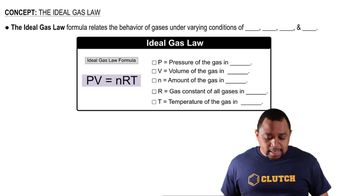
Ideal Gas Law

The ideal gas law is a fundamental equation in chemistry that relates the pressure, volume, temperature, and number of moles of an ideal gas. It is expressed as PV = nRT, where P is pressure, V is volume, n is the number of moles, R is the ideal gas constant, and T is temperature in Kelvin. This law allows for the calculation of gas properties under various conditions, including determining partial pressures in equilibrium systems.
추천 영상:
가이드 코스
01:15
Ideal Gas Law Formula