Consider the following equilibrium, for which Kp = 0.0752 at 480ยฐC: 2 Cl2(g) + 2 H2O(g) โ 4 HCl(g) + O2(g) (b) What is the value of Kp for the reaction Cl2(g) + H2O(g) โ 2 HCl(g) + 1/2 O2(g)?
Ch.15 - Chemical Equilibrium
Brown14th EditionChemistry: The Central ScienceISBN: 9780134414232๋น์ ์ด ์ฌ์ฉํ๋ ๊ฒ ์๋๋ผ์?๊ต๊ณผ์ ๋ณ๊ฒฝ
15์ฅ, ๋ฌธ์ 25c
At 1000 K, ๐พ๐ = 1.85 for the reaction SO2(๐) + 12 O2(๐) โ SO3(๐) (c) What is the value of ๐พ๐ for the reaction in part (b)?
๊ฒ์ฆ๋ ๋จ๊ณ๋ณ ์๋ด1
Step 1: Understand the relationship between Kp and Kc. The relationship between Kp and Kc is given by the equation Kp = Kc(RT)^(ฮn), where R is the ideal gas constant (0.0821 Lยทatm/Kยทmol), T is the temperature in Kelvin, and ฮn is the change in moles of gas in the reaction.
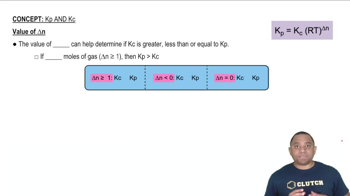
Step 2: Calculate ฮn for the reaction. ฮn is calculated as the difference between the total moles of gaseous products and the total moles of gaseous reactants. In this case, ฮn = (moles of SO3) - (moles of SO2 + moles of O2) = 1 - (1 + 1/2) = -1/2.
Step 3: Substitute the known values into the equation. We know that Kp = 1.85, R = 0.0821 Lยทatm/Kยทmol, T = 1000 K, and ฮn = -1/2. Substituting these values into the equation gives us 1.85 = Kc(0.0821*1000)^(-1/2).
Step 4: Solve the equation for Kc. To isolate Kc on one side of the equation, we need to divide both sides by (0.0821*1000)^(-1/2). This gives us Kc = 1.85 / (0.0821*1000)^(-1/2).
Step 5: Calculate the value of Kc. Now you can calculate the value of Kc using a calculator. Remember to follow the order of operations (PEMDAS/BODMAS) when performing the calculation.

๋น์ทํ ๋ฌธ์ ์ ๋ํ ๊ฒ์ฆ๋ ์์ ๋ต๋ณ:
์ด ์์ ํด๋ฒ์ ์ ๋ฌธ์ ์ ๋์์ด ๋๋ค๊ณ ํํฐ๋ค์ด ์ถ์ฒํ ๊ฒ์
๋๋ค.
์์ ๊ธธ์ด:
2m์ฃผ์ ๊ฐ๋
์ง๋ฌธ์ ์ฌ๋ฐ๋ฅด๊ฒ ๋ตํ๊ธฐ ์ํด ๋ฐ๋์ ์ดํดํด์ผ ํ๋ ํต์ฌ ๊ฐ๋
๋ค์ ๋ค์๊ณผ ๊ฐ์ต๋๋ค.
Equilibrium Constant (Kp and Kc)
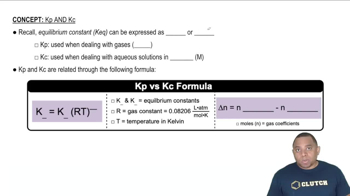
The equilibrium constant (K) quantifies the ratio of the concentrations of products to reactants at equilibrium. Kp is used for gas-phase reactions and is expressed in terms of partial pressures, while Kc is used for reactions in solution and is expressed in terms of molar concentrations. The relationship between Kp and Kc is given by the equation Kp = Kc(RT)^(ฮn), where ฮn is the change in moles of gas.
์ถ์ฒ ์์:
๊ฐ์ด๋ ์ฝ์ค
Kp vs. Kc Formula
Relationship between Kp and Kc
The relationship between Kp and Kc is crucial for converting between the two constants. This relationship depends on the temperature and the change in the number of moles of gas during the reaction. Specifically, Kp can be calculated from Kc using the formula Kp = Kc(RT)^(ฮn), where R is the ideal gas constant and T is the temperature in Kelvin.
์ถ์ฒ ์์:
๊ฐ์ด๋ ์ฝ์ค
Kp vs Kc Relationship
Stoichiometry of the Reaction
Understanding the stoichiometry of the reaction is essential for determining ฮn, which is the difference in moles of gaseous products and reactants. In the given reaction, the stoichiometry indicates that for every mole of SO2 and 12 moles of O2, 1 mole of SO3 is produced. This information is necessary to calculate the change in moles of gas, which directly affects the conversion between Kp and Kc.
์ถ์ฒ ์์:
๊ฐ์ด๋ ์ฝ์ค
Stoichiometry Concept
๊ด๋ จ ์ค์ฒ
๊ต๊ณผ์ ์ง๋ฌธ
๊ต๊ณผ์ ์ง๋ฌธ
Consider the following equilibrium, for which ๐พ๐ = 0.0752 at 480ยฐC: 2 Cl2(๐) + 2 H2O(๐) โ 4 HCl(๐) + O2(๐) (a) What is the value of ๐พ๐ for the reaction 4 HCl(๐) + O2(๐) โ 2 Cl2(๐) + 2 H2O(๐)?
1048
views
๊ต๊ณผ์ ์ง๋ฌธ
Consider the following equilibrium: 2 H2(g) + S2(g) โ 2 H2S(g) Kc = 1.08 ร 107 at 700ยฐC (c) Calculate the value of ๐พ๐ if you rewrote the equation H2(g) + 1/2 S2(g) โ H2S(g)
1595
views
๊ต๊ณผ์ ์ง๋ฌธ
The following equilibria were attained at 823 K:
CoO(s) + H2(g) โ Co(s) + H2O(g) Kc = 67
CoO(s) + CO(g) โ Co(s) + CO2(g) Kc = 490
Based on these equilibria, calculate the equilibrium constant for H2(g) + CO2(g) โ CO(g) + H2O(g) at 823 K.
127
views