Ch.15 - Chemical Equilibrium
15์žฅ, ๋ฌธ์ œ 56a

At 80ยฐC, ๐พ๐‘ = 1.87ร—10โˆ’3 for the reaction PH3BCl3(๐‘ ) โ‡Œ PH3(๐‘”) + BCl3(๐‘”) (a) Calculate the equilibrium concentrations of PH3 and BCl3 if a solid sample of PH3BCl3 is placed in a closed vessel at 80ยฐC and decomposes until equilibrium is reached.

๊ฒ€์ฆ๋œ ๋‹จ๊ณ„๋ณ„ ์•ˆ๋‚ด
1
Write the balanced chemical equation for the reaction: PH3BCl3(s) โ‡Œ PH3(g) + BCl3(g).
Set up an ICE (Initial, Change, Equilibrium) table. Since PH3BCl3 is a solid, its concentration does not appear in the expression for Kc. Assume initial concentrations of PH3 and BCl3 to be 0 M.
Let x be the change in concentration of PH3 and BCl3 as PH3BCl3 decomposes. At equilibrium, the concentrations of PH3 and BCl3 will both be x M.
Write the expression for the equilibrium constant, Kc, in terms of x: Kc = [PH3][BCl3]. Substitute the equilibrium concentrations into this expression to get Kc = x^2.
Solve the equation Kc = x^2 for x to find the equilibrium concentrations of PH3 and BCl3. Use the given value of Kc = 1.87ร—10โˆ’3 to find the value of x.

๋น„์Šทํ•œ ๋ฌธ์ œ์— ๋Œ€ํ•œ ๊ฒ€์ฆ๋œ ์˜์ƒ ๋‹ต๋ณ€:

์ด ์˜์ƒ ํ•ด๋ฒ•์€ ์œ„ ๋ฌธ์ œ์— ๋„์›€์ด ๋œ๋‹ค๊ณ  ํŠœํ„ฐ๋“ค์ด ์ถ”์ฒœํ•œ ๊ฒƒ์ž…๋‹ˆ๋‹ค.
์˜์ƒ ๊ธธ์ด:
1m

์ฃผ์š” ๊ฐœ๋…

์งˆ๋ฌธ์— ์˜ฌ๋ฐ”๋ฅด๊ฒŒ ๋‹ตํ•˜๊ธฐ ์œ„ํ•ด ๋ฐ˜๋“œ์‹œ ์ดํ•ดํ•ด์•ผ ํ•˜๋Š” ํ•ต์‹ฌ ๊ฐœ๋…๋“ค์€ ๋‹ค์Œ๊ณผ ๊ฐ™์Šต๋‹ˆ๋‹ค.

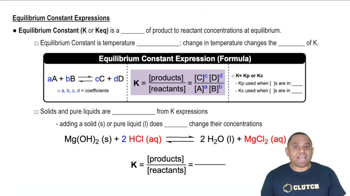
Equilibrium Constant (Kc)

The equilibrium constant (Kc) is a numerical value that expresses the ratio of the concentrations of products to reactants at equilibrium for a given reaction at a specific temperature. For the reaction PHโ‚ƒBClโ‚ƒ(s) โ‡Œ PHโ‚ƒ(g) + BClโ‚ƒ(g), Kc = [PHโ‚ƒ][BClโ‚ƒ] / [PHโ‚ƒBClโ‚ƒ]. Since solids do not appear in the expression, Kc only involves the gaseous products.
์ถ”์ฒœ ์˜์ƒ:
๊ฐ€์ด๋“œ ์ฝ”์Šค
03:20
Equilibrium Constant Expressions

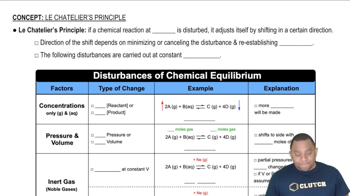
Le Chatelier's Principle

Le Chatelier's Principle states that if a dynamic equilibrium is disturbed by changing the conditions, the system will adjust to counteract the change and restore a new equilibrium. In this case, if PHโ‚ƒBClโ‚ƒ decomposes, the system will shift to produce more PHโ‚ƒ and BClโ‚ƒ until the concentrations reach a state that satisfies the equilibrium constant.
์ถ”์ฒœ ์˜์ƒ:

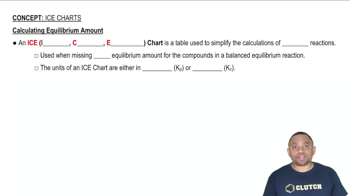
ICE Table (Initial, Change, Equilibrium)

An ICE table is a tool used to organize the initial concentrations, the changes in concentrations, and the equilibrium concentrations of reactants and products in a chemical reaction. For this reaction, the initial concentration of PHโ‚ƒBClโ‚ƒ is known, and as it decomposes, the changes in concentrations of PHโ‚ƒ and BClโ‚ƒ can be calculated to find their equilibrium concentrations using the Kc value.
์ถ”์ฒœ ์˜์ƒ:
๊ฐ€์ด๋“œ ์ฝ”์Šค
01:14
ICE Charts and Equilibrium Amount
๊ด€๋ จ ์‹ค์ฒœ