Ch.15 - Chemical Equilibrium
15์žฅ, ๋ฌธ์ œ 58

At 25ยฐC, the reaction CaCrO4(๐‘ ) โ‡Œ Ca2+(๐‘Ž๐‘ž) + CrO42โˆ’(๐‘Ž๐‘ž) has an equilibrium constant ๐พ๐‘ = 7.1ร—10โˆ’4. What are the equilibrium concentrations of Ca2+ and CrO42โˆ’ in a saturated solution of CaCrO4?

๊ฒ€์ฆ๋œ ๋‹จ๊ณ„๋ณ„ ์•ˆ๋‚ด
1
Identify the reaction and write the equilibrium expression. For the dissolution of CaCrO4, the reaction is: CaCrO4(s) โ‡Œ Ca2+(aq) + CrO42โˆ’(aq). The equilibrium expression is Kc = [Ca2+][CrO42โˆ’].
Set up an ICE table (Initial, Change, Equilibrium) to track the concentrations of the ions. Initially, the concentrations of Ca2+ and CrO42โˆ’ are 0. Let x be the change in concentration of Ca2+ and CrO42โˆ’ as CaCrO4 dissolves.
At equilibrium, the concentrations of Ca2+ and CrO42โˆ’ will both be x. Substitute these values into the equilibrium expression: Kc = x * x = x^2.
Solve for x by taking the square root of both sides of the equation Kc = x^2. This gives x = sqrt(Kc).
Substitute the value of Kc (7.1ร—10โˆ’4) into the equation for x to find the equilibrium concentrations of Ca2+ and CrO42โˆ’.

๋น„์Šทํ•œ ๋ฌธ์ œ์— ๋Œ€ํ•œ ๊ฒ€์ฆ๋œ ์˜์ƒ ๋‹ต๋ณ€:

์ด ์˜์ƒ ํ•ด๋ฒ•์€ ์œ„ ๋ฌธ์ œ์— ๋„์›€์ด ๋œ๋‹ค๊ณ  ํŠœํ„ฐ๋“ค์ด ์ถ”์ฒœํ•œ ๊ฒƒ์ž…๋‹ˆ๋‹ค.
์˜์ƒ ๊ธธ์ด:
2m

์ฃผ์š” ๊ฐœ๋…

์งˆ๋ฌธ์— ์˜ฌ๋ฐ”๋ฅด๊ฒŒ ๋‹ตํ•˜๊ธฐ ์œ„ํ•ด ๋ฐ˜๋“œ์‹œ ์ดํ•ดํ•ด์•ผ ํ•˜๋Š” ํ•ต์‹ฌ ๊ฐœ๋…๋“ค์€ ๋‹ค์Œ๊ณผ ๊ฐ™์Šต๋‹ˆ๋‹ค.

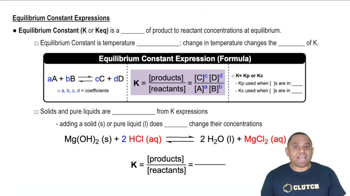
Equilibrium Constant (Kc)

The equilibrium constant (Kc) is a numerical value that expresses the ratio of the concentrations of products to reactants at equilibrium for a given reaction at a specific temperature. For the reaction CaCrOโ‚„(s) โ‡Œ Caยฒโบ(aq) + CrOโ‚„ยฒโป(aq), Kc indicates how far the reaction favors the formation of products. A small Kc value, like 7.1ร—10โปโด, suggests that at equilibrium, the concentration of reactants is much higher than that of products.
์ถ”์ฒœ ์˜์ƒ:
๊ฐ€์ด๋“œ ์ฝ”์Šค
03:20
Equilibrium Constant Expressions

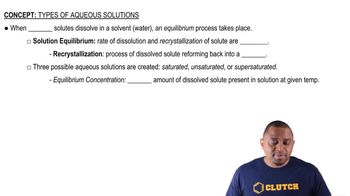
Saturated Solution

A saturated solution is a solution that contains the maximum concentration of a solute that can dissolve at a given temperature and pressure. In the context of the reaction, a saturated solution of CaCrOโ‚„ means that the solution has reached a point where no more CaCrOโ‚„ can dissolve, and the concentrations of Caยฒโบ and CrOโ‚„ยฒโป ions are at their equilibrium values, determined by the Kc of the reaction.
์ถ”์ฒœ ์˜์ƒ:

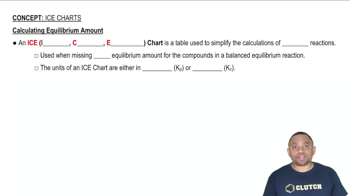
ICE Table (Initial, Change, Equilibrium)

An ICE table is a tool used to organize the initial concentrations, changes in concentrations, and equilibrium concentrations of reactants and products in a chemical reaction. For the given reaction, the ICE table helps to set up the relationship between the initial concentration of CaCrOโ‚„, the changes in concentrations of Caยฒโบ and CrOโ‚„ยฒโป as the system reaches equilibrium, and ultimately allows for the calculation of their equilibrium concentrations using the Kc value.
์ถ”์ฒœ ์˜์ƒ:
๊ฐ€์ด๋“œ ์ฝ”์Šค
01:14
ICE Charts and Equilibrium Amount